


As one of the earliest locales to host data centers, the U.S. state of Oregon may give us a preview of how the next round of data-center discourse will proceed. Starting in 2006, companies like Google and Facebook (Meta) discovered the eastern part of the state was a dream-fit for their power-hungry computer farms. Sparsely populated, overflowing with abundant electricity from regional hydropower, and readymade for fresh wind and solar, these drylands along the eastern Columbia River saw tremendous data center growth for over a decade. Importantly, there was no public panic about their arrival, nor was there any protest. Unsurprisingly, local communities and rural governments largely welcomed this early generation of internet infrastructure for the usual reasons: economic development and jobs. You can see in today’s state map of data centers the footprints of this first wave, and how data center capacity today remains concentrated in the eastern two-thirds of the state.
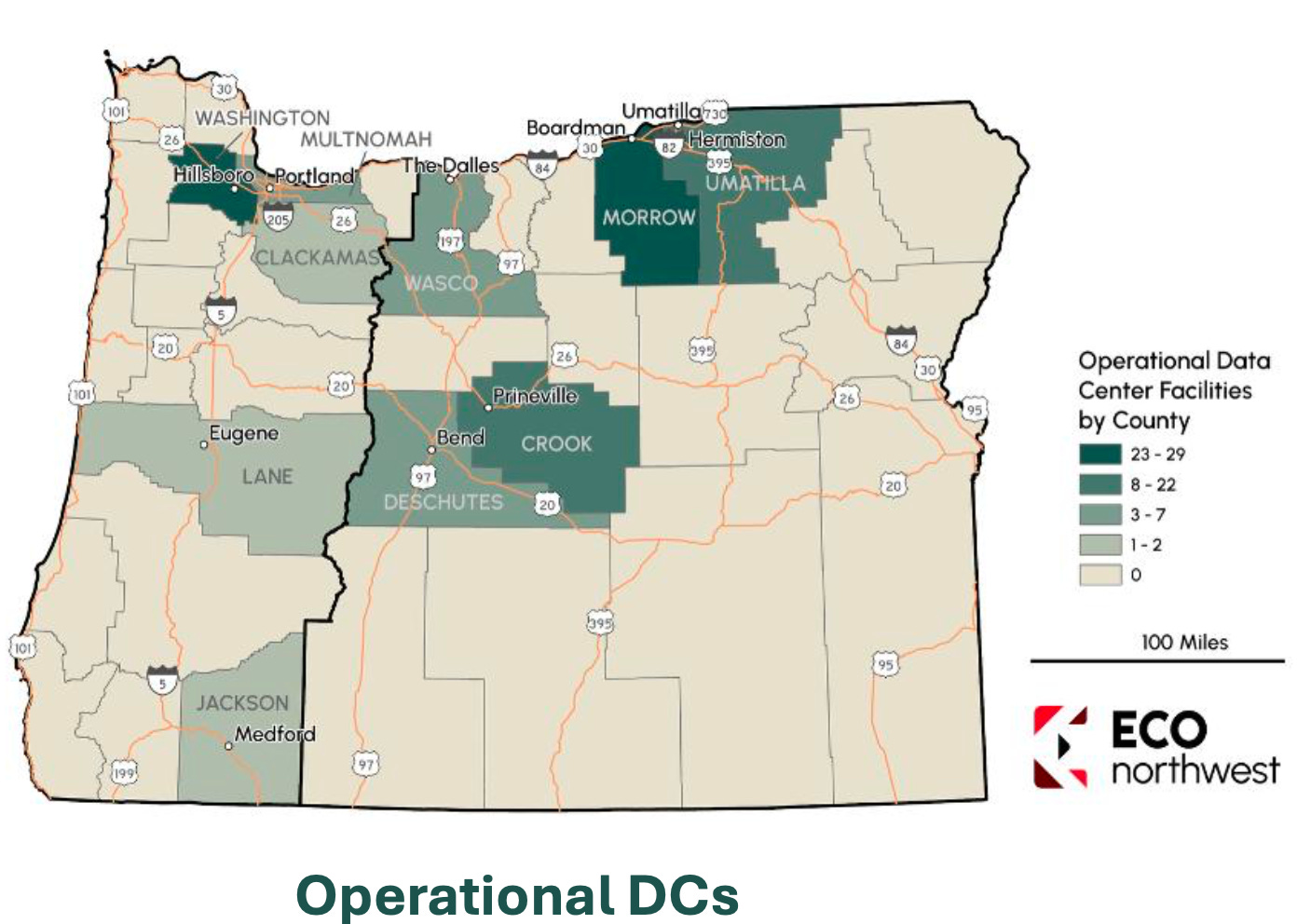
The map is from a study funded by the Lemelson Foundation of Portland, and conducted by ECOnorthwest and the University of Virginia. One of the data points that may surprise people is that data centers now take nearly 25% of Oregon’s total power consumption. That obviously seems high but two data points are necessary to put that large share in proportion. First, Oregon is the 9th largest state in the U.S. by land area but its population, at only 4.3 million, is only the 27th most populous. Oregon’s territory is much larger than many understand: at 98,380 square miles, you could fit the state of Massachusetts, at 10,555 square miles, into Oregon nearly 9 times. So one answer to the question of the Oregon public’s historical lack of alarm about data center construction may simply be that the points of contact between data centers and population have so far been few. Put another way, Oregon’s per capita electricity consumption is the 3rd lowest in the U.S.
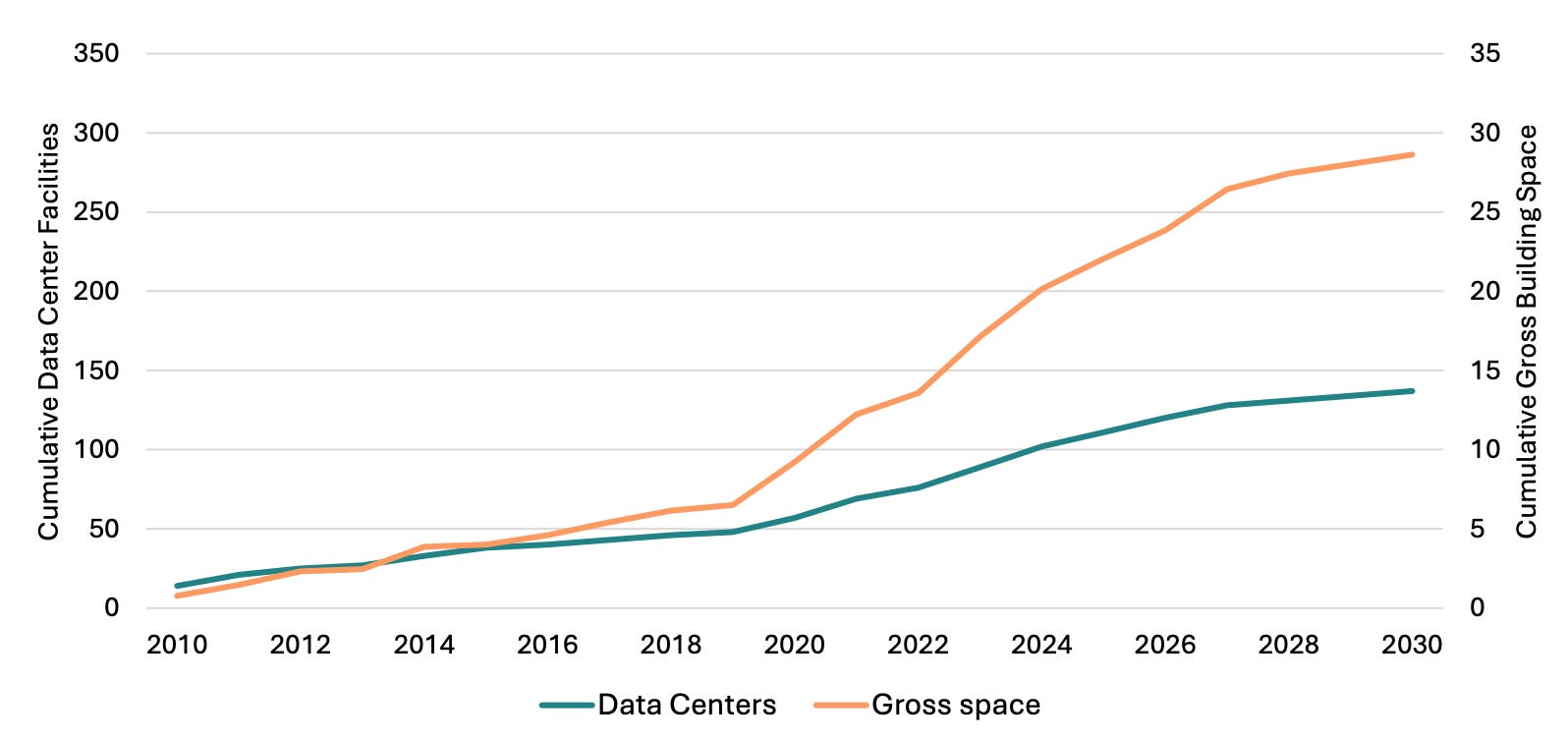
This is going to change. Data center growth in the eastern two-thirds of the state is expected to grow just 18% over the next five years, but growth in the western third is expected to grow by 80%. According to the study, not only are construction plans migrating west to the more populous side of the state, but the growing size of each data center, already expanding quickly, is clearly the new trend—a shift that appears to have begun during the pandemic. As the study says, “Oregon did not become more exposed to data centers only because more facilities were added. It became more exposed because newer facilities were much larger.”
Helpfully, Oregon in the past decade has become a quiet giant of wind power which has roughly grown from 2% of Oregon’s total generation to 14% presently. The study however does not address how the next wave of data centers will be powered. But given the political environment in Oregon, building them with behind-the-meter natural gas turbines will be challenging, to say the least. Just to remind, data centers have historically been built with a connection to the grid, and on-site generators as temporary back-up. As readers are no doubt aware, the current trend is to fully morph this back-up capacity into primary power, utilizing much larger arrays of natgas turbines—a tactic that reflects how hard it’s become to actually get a grid connection. In Oregon at least, these configurations will have to face the state DEQ, and its rules.