


The Trump administration continues to find clever ways to cancel wind and solar projects. Their most recent success is exceptionally destructive, as they’ve found a way to scuttle the gargantuan Nevada-based solar project Esmeralda 7, which was slated to top out at a head-spinning 6.2GW of capacity, spread across nearly 200 square miles of land. A quick review of the global solar table shows that Esmeralda would not just have been the largest solar array in the United States, but would have landed immediately in the top ten solar plants in the world. There is only one word to describe this administration’s efforts: madness.
The most recent cancellation comes at a time when everyone from utility and power professionals to energy sector generalists agree that growing imbalances between U.S. electricity supply and demand are on a collision course. Actually, it’s worse than that. Supply and demand imbalances were already in the queue prior to 2025, when U.S. power demand finally jumped out of its long-stagnant range as electrification itself started to take hold, and the construction boom of AI data centers began in earnest. John Arnold, former natural gas trader and now philanthropist and policy advocate, had this to say upon learning of the Esmeralda cancellation:

While it goes without saying, the Trump administration is so broadly incompetent that it appears not to have occurred to them that “the electric bill” is a reality that permeates American society, not unlike the grocery bill and prices at the pump. Indeed, it is almost surely the case that the administration believes it can marshal all the power the U.S. grid needs from coal and natural gas new build—entirely forgetting that those construction projects take time, often much time, to complete. Now add to this heap of trouble the fact that cooling days are on the rise in much of the U.S., placing further upward pressure on the grid to serve demand. It’s a very ugly picture.
At what point do Republicans in a state like Nevada (and others) realize that “the electric bill” is likely to be a major talking point in next year’s midterm elections? Perhaps more quickly than you expect: the Republican governor of Nevada is not happy about the cancellation.
Wind and solar have made a critically important contribution to the U.S. power grid by being the go-to, quickly deployable solution to U.S. electricity demand growth. For the past five years—and so far in 2025 as well—combined wind and solar have pretty much covered all the growth in U.S. electricity. That’s a big deal, especially given that U.S. power demand is on course this year to be up a cumulative 9.0% since 2021. Cold Eye Earth takes the view that if the Trump administration doesn’t reverse course on its attempt to suppress wind and solar growth, the portion of marginal growth that would have otherwise come from wind and solar will not be adequately covered by coal and/or natural gas. Demand is moving too swiftly to the upside. Only wind and solar can move that fast. (Note on active charts: the chart below is active and can be toggled to show totals for each category: ex-wind+solar; and wind+solar. But the active chart is only responsive only at the Cold Eye Earth website, not in this email.)
The IEA has slightly downgraded its renewables growth forecast for the U.S. this year. No surprise. But the agency maintains that solar is storming the planet and is on course to provide 80% of total global renewables growth from now to the end of the decade. Particularly encouraging is the IEA’s assessment that India is now ready to take its place behind China as the world’s second-largest market for renewables. Well, let’s hope that’s the case, because India, on a population-adjusted basis, is far, far behind other large regions when we use the solar-per-capita measure.
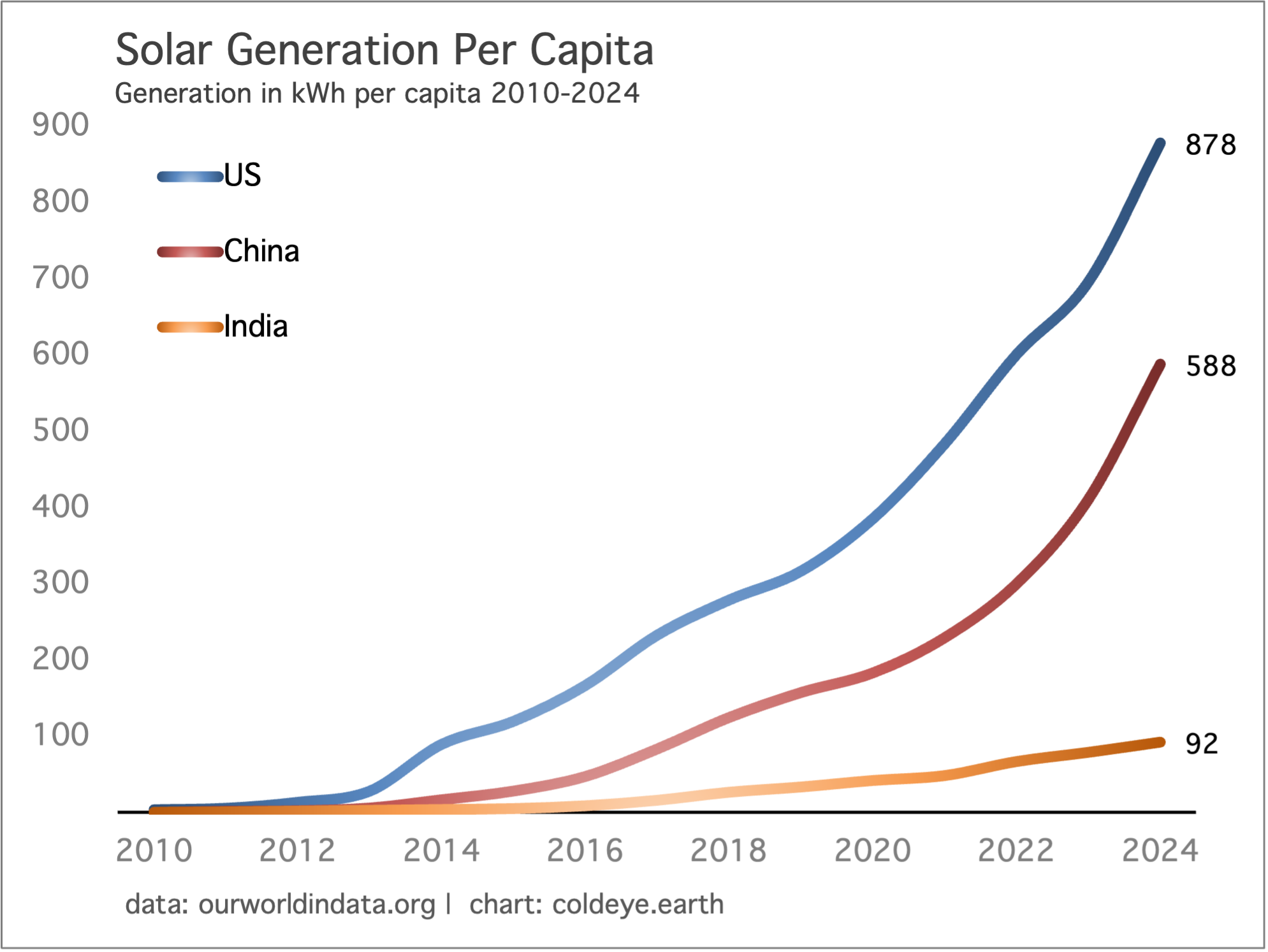
Worse, India’s solar growth rates continue to be weak. Last year, total solar generation grew just 17% there, while U.S. solar generation grew 26% and China’s grew 43%. This gap is even more stark when you consider that it’s far harder for China to grow solar 43% in a year because it has been manically growing solar for years. India’s solar, coming up from a low base, shouldn’t be growing 17% per annum but more like 50%.
Cold Eye Earth also finds itself looking askance at the IEA’s practice of loading up the renewables category with every imaginable energy source that’s not fossil fuels. This practice is also happening elsewhere in the energy think-tank world, in what appears to be a transparently comical effort to achieve “number go up!” While it’s true that our categories need some revision, we really need to stop including biofuels in the category—nuclear too. One of the deeper ironies here is that most renewables advocates agree that biofuels are ridiculous—a thin, low-energy content solution that barely offers a net energy gain (if at all) after you expend the energy required to process them. Worse, most biofuels are combusted! Perhaps we should have combustibles and non-combustibles as categories.
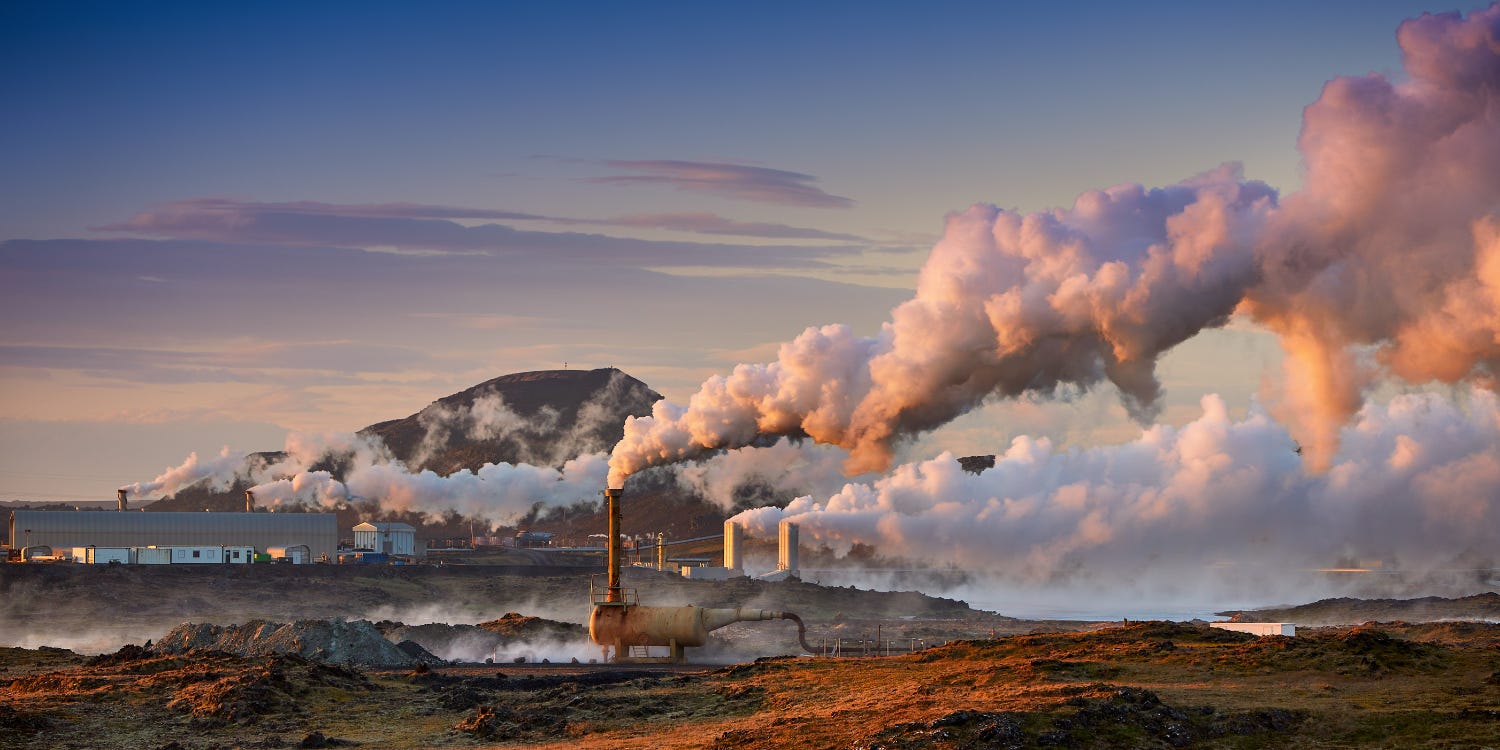
One emerging source of renewable energy that’s truly exciting is geothermal. Indeed, like solar and wind, geothermal is an energy-collection technology. We could say that energy-collection technologies have an intrinsic elegance, a basic simplicity, that’s dependable and sustainable. Yes, geothermal requires some excavation and no doubt some ongoing energy inputs. But tapping into existing earthly heat sources and channeling them to produce power is rich with possibility.
Bloomberg reports that markets are indicating their enthusiasm for geothermal as lease prices soar for prospective geothermal areas of land. From the article Companies Are Paying Record Sums to Develop Geothermal Energy:
Average prices for public land leases for geothermal energy development soared by 282% this year to $127 per acre, driven by growing energy demand from data centers and President Donald Trump’s administration embracing the energy source. The record prices are a major step up from $33 per-acre average last year, according to data from the US Bureau of Land Management, the agency that conducts the auctions.
Further reading:
Newsom signs 1 bill to speed geothermal approvals, vetoes another.
The Future of Geothermal Energy.
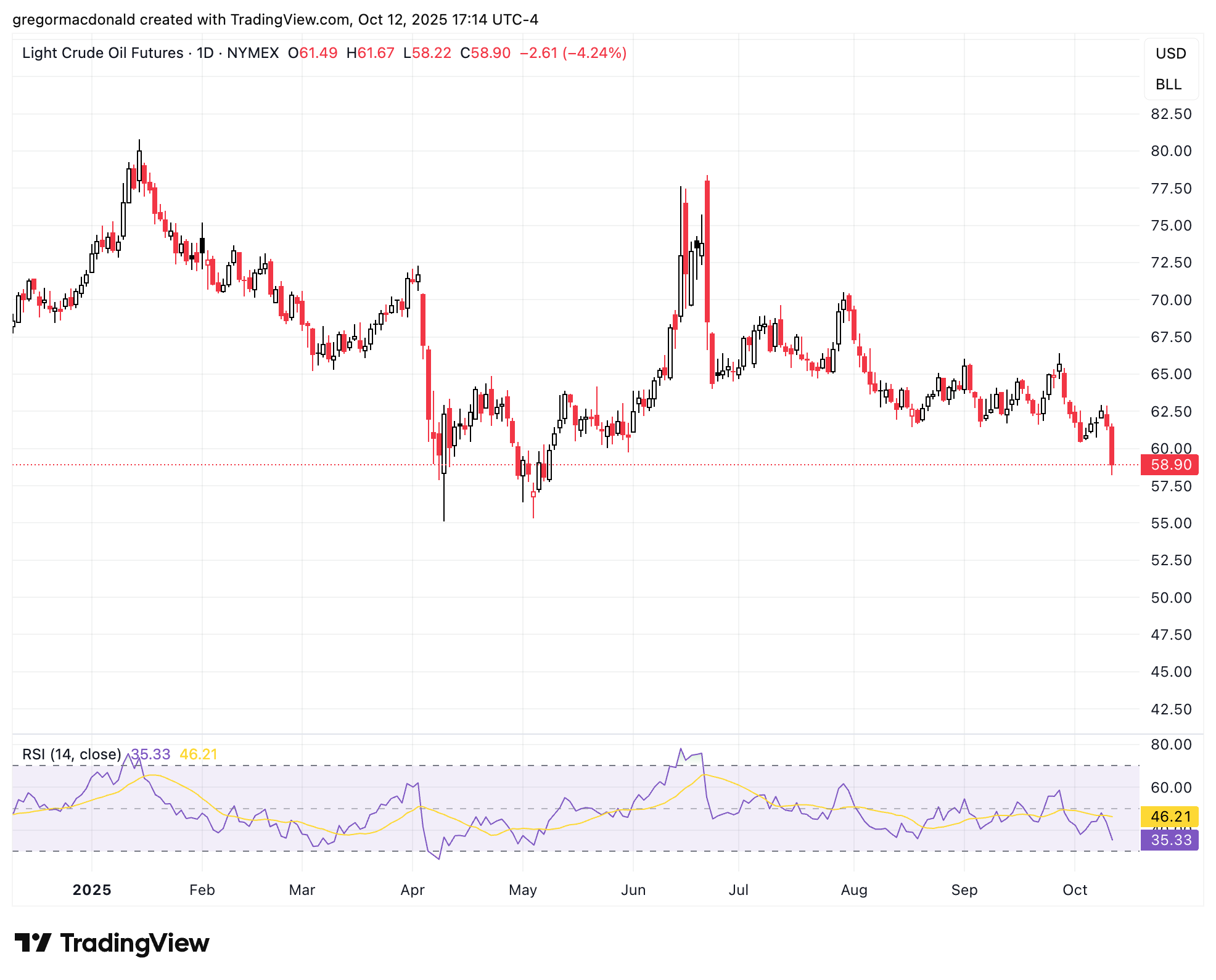
Oil prices fell back below $60 a barrel last week, as an already weak futures market succumbed to yet another emotional eruption from the U.S. president. Friday’s punishing liquidation, which hit crypto markets the hardest, and technology equities quite badly, and left broad indexes like the S&P 500 down 2.7%, also pulled down oil—enough so to trade with “a five handle” on crude. (That’s trader talk for: NYMEX crude fell into the 50s.).
But of course, oil has been sustainably weak for some time now. Worldwide electrification is pressing onward. China has literally transformed its vehicle fleet in just one decade. And it’s no longer clear that oil has any notable demand driver that could firm up the market. It’s less the case that oil is in trouble, and really more the case that nothing is coming to rescue oil from its fate: a long, stagnant period of no growth.
You know what? We should all congratulate the research team at British Petroleum, which in 2019 forecast that by the year 2025 oil demand growth would be scant to non-existent. Well done, BP!
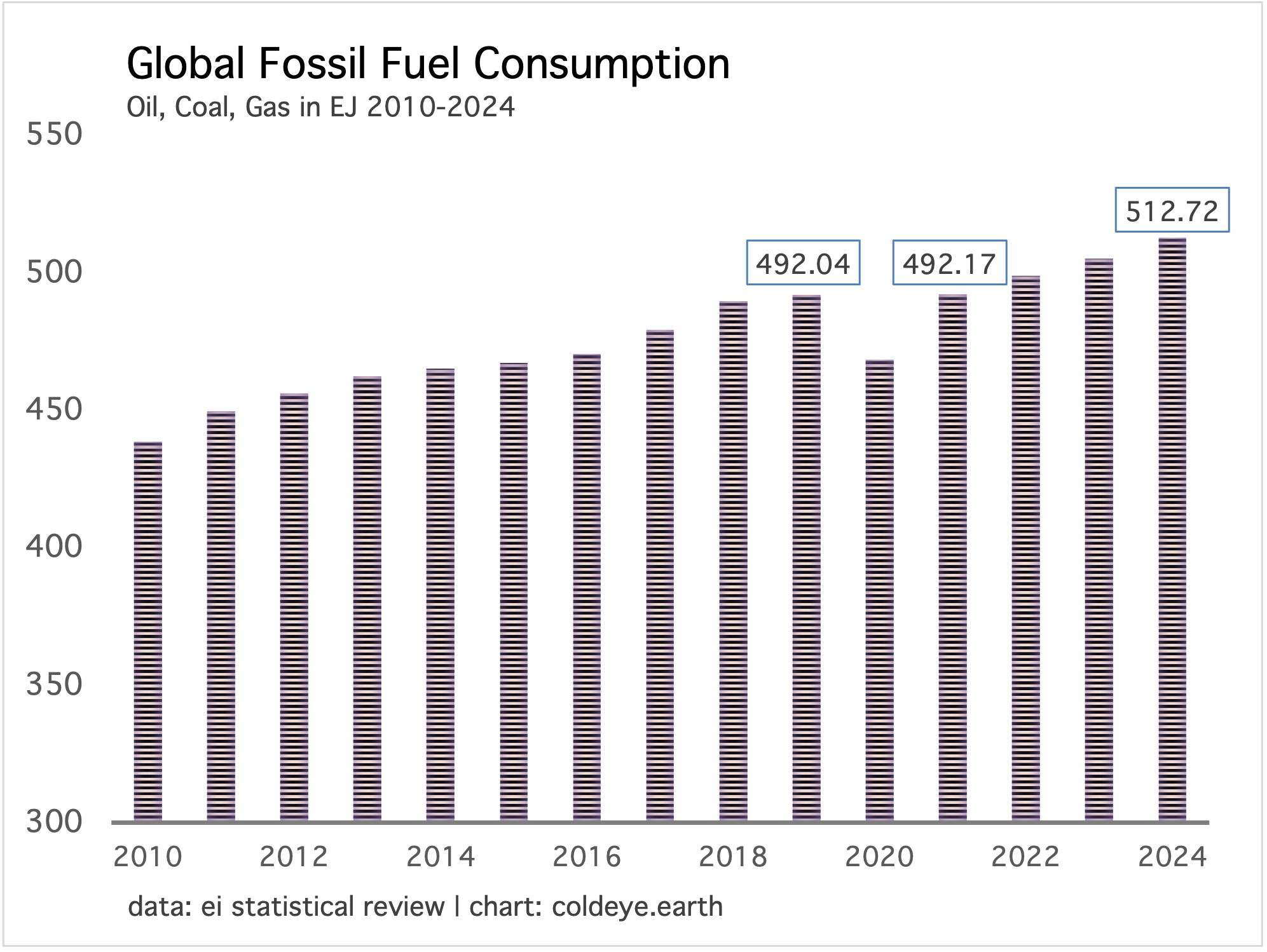
We must always remind ourselves that energy transition discourse invariably winds up concentrating on electricity. And electricity accounts for only 20% of total global energy consumption. Global transportation, meanwhile, accounts for about 30% of total global energy consumption. Accordingly, we can say with some justification that the world is currently making moderate progress in decarbonizing the two sectors most easily suited to the process: power, through renewables, and transportation, through the electric drivetrain. So at least we are making progress on half of the problem. But it’s still too early to conclude that this has sustainably slowed down the growth rate of total fossil fuel consumption. Indeed, after the disruption of the global pandemic in 2020-2021, the world got right back on track in 2022-2024 by growing fossil fuel demand by the usual 1.2% - 1.5% rate. In 2024, growth was at the top of that range, in fact. Finally, not to name names, but it’s frustrating and rather sad to think of all the energy analysts who declared that fossil fuel consumption peaked with the pandemic.
—Gregor Macdonald