Americans aren’t buying what President Trump is selling. In a televised speech to the nation last week, the president once again laid out a series of incoherent arguments in his ongoing attempt to explain the war. The attack on Iran, apparently, is simultaneously a war of choice and something that was necessary. The closing of the Strait of Hormuz, meanwhile, occupies not two but several conflicting framings: an action taken by Iran that has nothing to do with the war; a condition that will dissipate naturally all on its own; and a problem the rest of the world needs to solve, because the U.S. is on the verge of washing its hands of any responsibility for its future protection. The president followed up his speech several days later with a bizarre Truth Social post on Easter Sunday, in which he praised Allah, dropped an f-bomb, and threatened Iran with total annihilation if they do not open the Strait. Betting markets responded to the whiff of executive-branch desperation by pushing the Impeachment contract at Kalshi to new highs, raising the odds to nearly 26% that Trump is both impeached (in the House) and convicted (in the Senate). Just to add, that is functionally a parlay bet, relying on not one but two outcomes to pay out.
A practice most professional bullshitters generally respect when baffling audiences is the disciplined avoidance of any details. Here the president failed to adhere to that tactic when he asserted, several times and forcefully, that the passage of ships through the Gulf has no effect on the U.S. or its economy. His reason? We produce our own oil and don’t need any Gulf oil. Observers have often remarked that Donald Trump genuinely doesn’t understand how complex, contingent systems work—such as the global economy and all its interlocking parts—and here we have a tidy case study in the president’s deficiency.
But the president also committed a cardinal sin of politics: You cannot assert to the public specific claims that are easily falsifiable. Gasoline prices are available for all to see, and on a national average are back above $4.00 per gallon—last reached in 2022, at the outset of the Russia-Ukraine war. His assertion that the U.S. is insulated from the effects of high oil prices only has relevance to the country’s trade balance—not to the effect on American consumers. Unlike some other petrostates in history, the U.S. does not subsidize prices at the pump. We pay the global price. There is no local price. Clearly there’s a common intuition that big producer states of commodities confer cheap local prices to the domestic populace, but that’s possible only if you are not running a free market in those commodities at home. It’s easy to imagine someone making this same mistake, say, upon arriving in New Zealand assuming that, because that country is a huge exporter of dairy products, local milk will be cheap. Nope. The U.S. could double its production of oil and New Zealand could double its output of powdered milk and Americans and New Zealanders would still be paying the global price for oil and milk respectively.
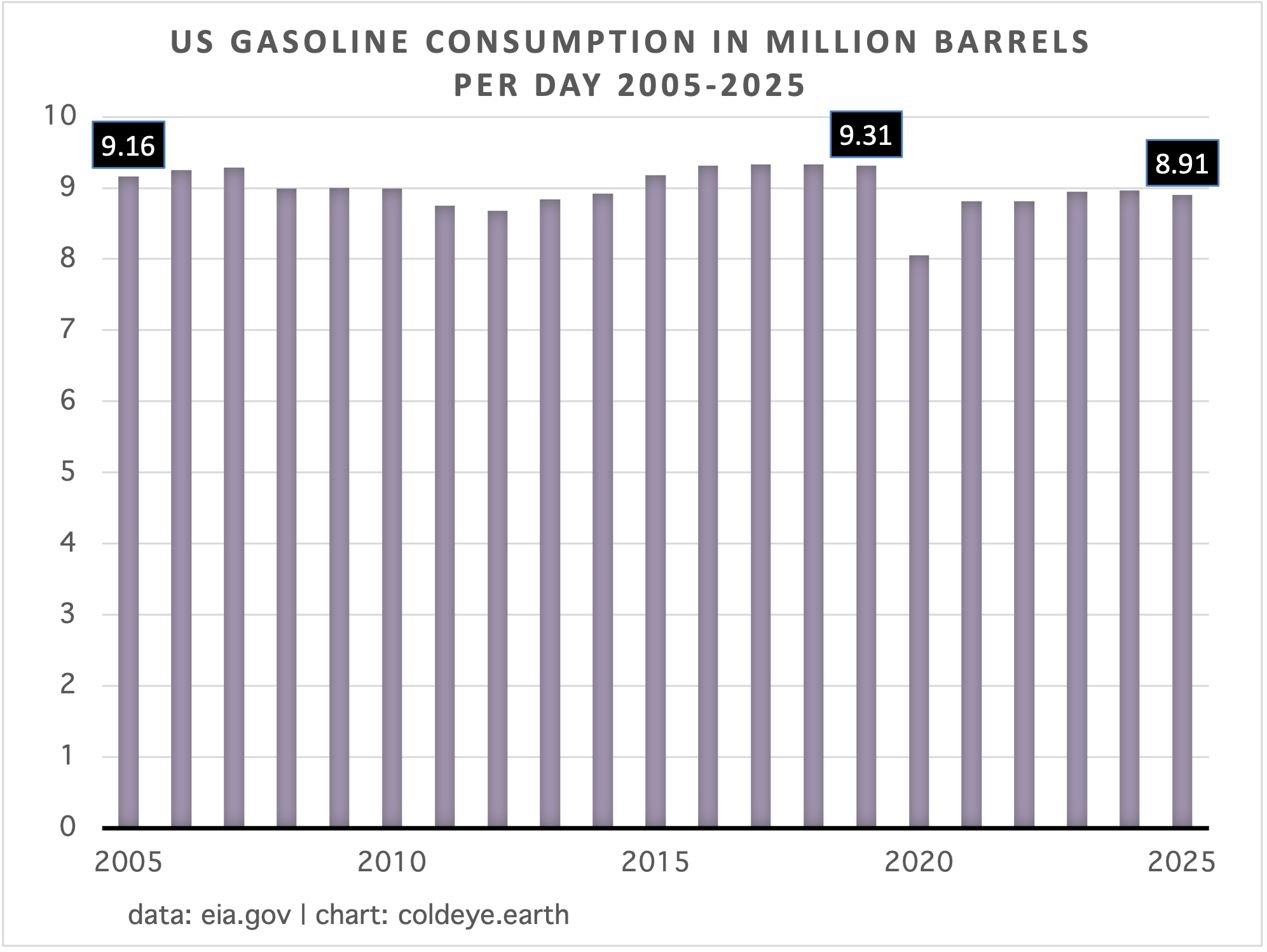
Here, we can assert a maxim: There is no way to reduce the hit to consumption from a spike in oil prices by producing more oil. If that were true, the U.S. would be basking in cheap oil prices right now, having nearly tripled its output of petroleum (not just crude) since the low-output years, around 2005. On the contrary, the U.S. has done basically nothing to reduce its structural dependency on gasoline—though you could assert it’s a form of accomplishment to have held consumption steady as the population grew over the past two decades.