


Global power generation from wind and solar has reached a level that’s equal to total generation from all sources in the United States. And this is 2024 data — 2025 data will arrive in late spring—so global wind and solar have almost certainly risen above this level. Recorded at 4,623 TWh of generation in 2024, global wind and solar likely added another 800 TWh in 2025 and now roughly generate about 5,400 TWh annually. That is very strong growth.
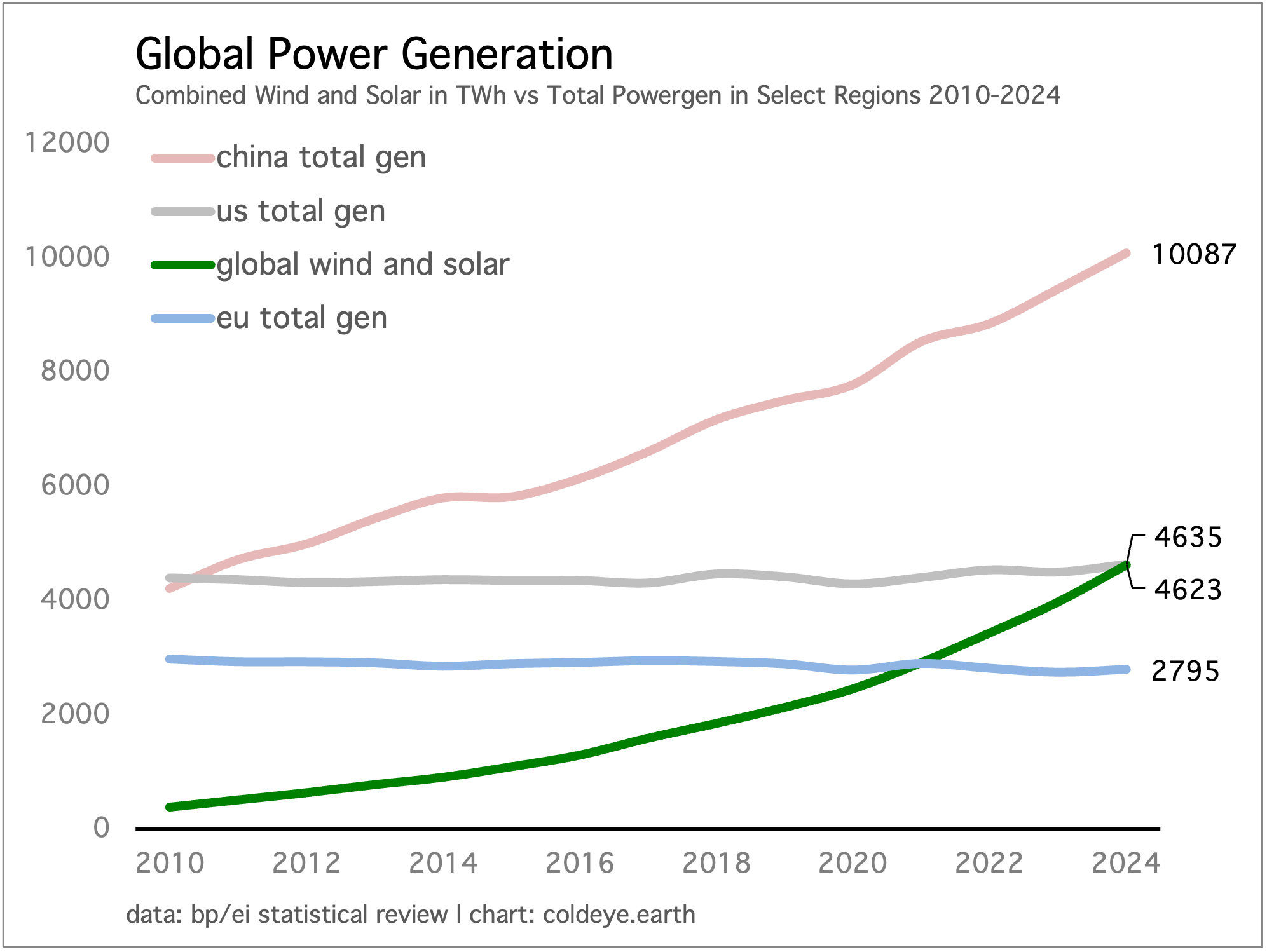
Indeed, the growth of wind and solar globally has been so strong that they equalled the total generation from all sources in the EU as recently as 2021, right around the 2,900 TWh level. Only three years were required to grow global wind and solar generation another 1,700 TWh to the 2024 level of 4,623 TWh. While the effort to kick off actual declines in global generation from fossil fuels remains a difficult problem to solve, there is clearly no problem at all with either the rate or the volume of wind and solar growth globally.
The most important metric for power sector decarbonization is of course total global demand growth for power, and 2025 has turned out to be notably weaker than expected. When we measure how much of this new demand globally is matched by the growth of wind and solar generation, weaker growth in total demand naturally lowers the success threshold for wind and solar, in their ongoing effort to entirely kill the growth of fossil fuel generation. Most estimates of last year’s total demand growth from all sources point to a 3.3% annual increase—far below the 4.3% increase in 2024 and also below the IEA’s previous headline forecast for three straight years of 4.0% (or even higher) growth.
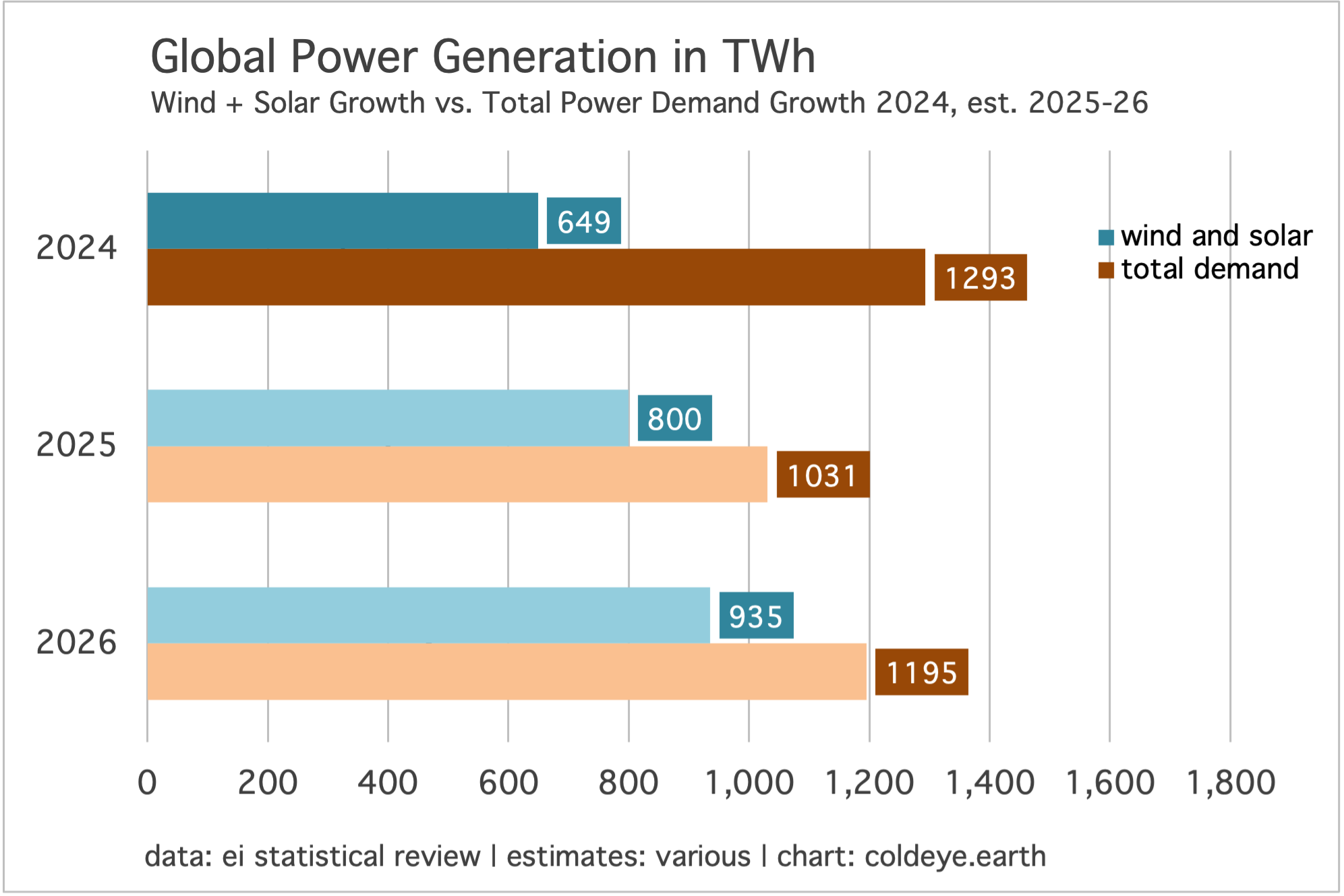
Setting aside the percentages for a moment, it’s not hard or complicated to understand the basic proposition here: If total wind and solar generation added a fresh 800 TWh, we need total global power demand growth to either match that volume or, better still, fall below it. Alas, even with last year’s slower growth in total demand, wind and solar once again did not (quite) cover that gain. This also means that unless hydropower or nuclear power came to the rescue last year (again, we are still working with estimates until official 2025 data is released), then global power sector emissions either increased or stayed flat.
So how has 2025 shaped up so far, as we put it all together? Wind and solar growth are a tad stronger, and total demand is a tad weaker, but combined wind and solar have once again missed out on covering all the growth. Based on current estimates, 2025 likely saw 1,031 TWh of total demand growth, against wind and solar’s 800 TWh. Furthermore, using an updated IEA estimate of 3.7% for 2026 total power demand growth, the projection suggests once again that wind and solar growth don’t quite make it across the line.
Cold Eye Earth would like to remind readers of two concepts that are truly helpful in understanding the interplay between the growth of clean generation, and legacy, incumbent generation:
A small thing growing fast is a powerful phenomenon that will shock you with its ability to overtake a large thing.
A large thing growing slowly can be devilishly hard to constrain, and will resist its overthrow durably for a long period of time.
We see the same phenomenon across a number of domains, including the intellectual realm, where new and popular ideas can grow and spread quickly, even as older, incumbent ideas that “should have died already!” press onward.
One way these kinds of accretive trajectories can play out is through a sort of collapse, in which incumbency or the status quo is eroded at its base for a long while and finally topples over after somehow managing to stay upright for much longer than most would have expected. It’s harder to see such an outcome in the world of global power, where hardware is dominant and decay is slow. Subsidy schemes, however, can help in producing collapse-like scenarios because they produce life extension in the sectors they seek to protect. So, for example, we have seen collapse unfold in regimes where a currency can no longer be supported, or sclerotic businesses fall apart when a tariff regime, meant to protect them, withers.
We might want to ask ourselves, for example, where might there be a large inventory of coal-based power generation that enjoys if not depends on strong state support? China. Not making predictions, but this is the kind of analysis that is worth pursuing. Wind and solar (and storage) will eventually cut into incumbent generation growth on a global basis, but we will still need to see the kind of collapse (again, as an example) that we saw in coal across the U.S. and EU starting around 2010. We have seen the collapse of China’s real estate sector in recent years—it’s not unthinkable that the same could happen to their bloated, under-utilized coal sector.
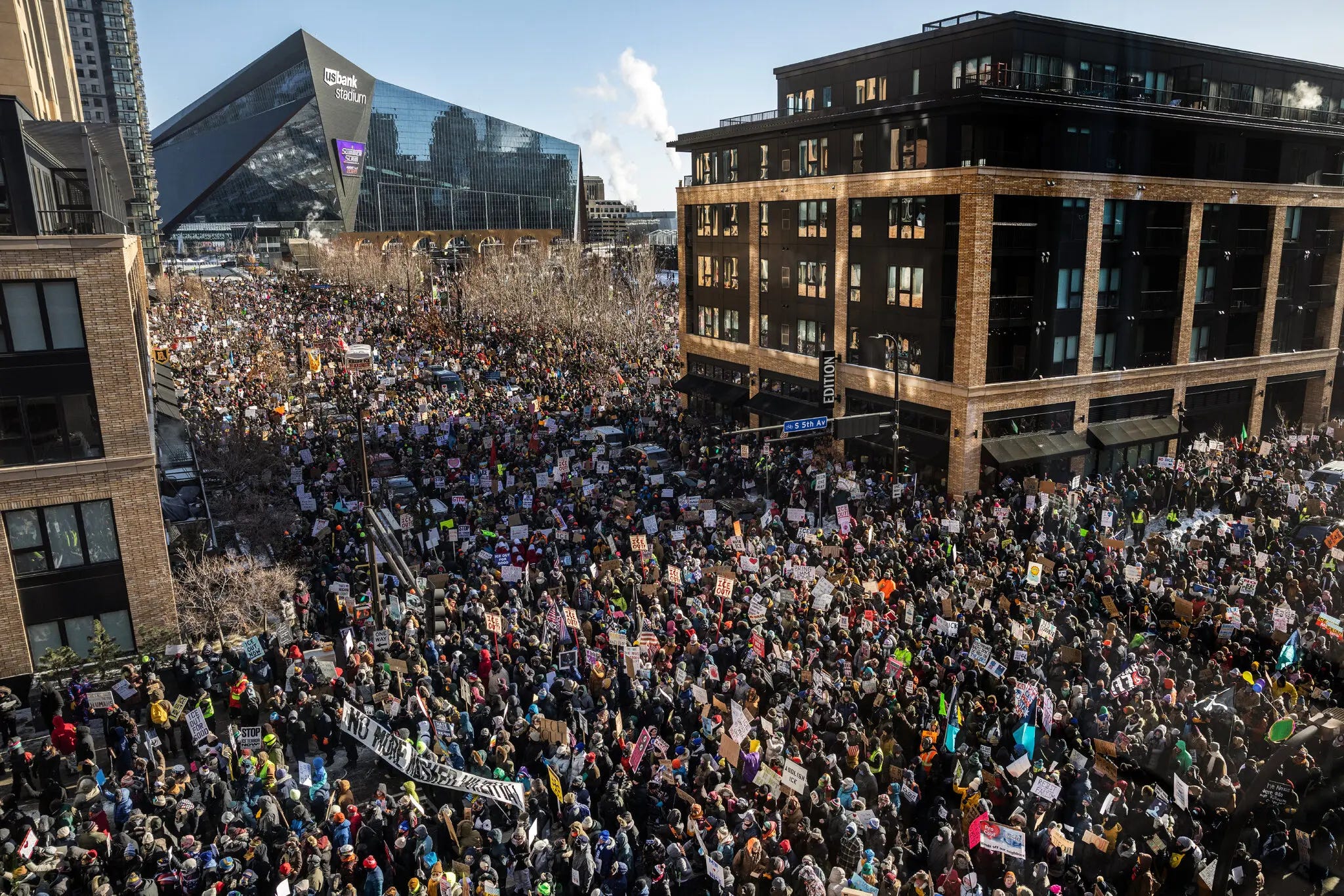
As a U.S. based publication Cold Eye Earth feels an obligation to briefly address the extraordinary events of the past week. Rather than passion however, here is a brief historical view that may shed some light: The modern constitutions of most western nations are quite clearly animated by the brutality, the tyranny, and the chronic dysfunction and injustice of the authoritarian political economies which dominated human existence for millennia. Free speech and assembly, trials composed of evidence and juries, and protection against garrisoned troops in cities, home invasion and assaults on the body are repeated themes across western legal frameworks for the very obvious reason that these were all long-endured flashpoints of suffering—seared into the collective memories of humanity.
The murders at the hand of the State which occurred in the Twin Cities of Minnesota this month hit the bullseye of these rights and liberties, and that is why the deaths of two—just two—innocent people are in fact a national crisis, which is now drawing the attention of citizens across the entirety of the political spectrum. The State then followed up these murders with a series of pronouncements and accusations that were so transparently false, that it offended not only everyone already shocked by the lethality of the State, but then brought along a new wave of Americans rightly offended that the State would lie to them so blatantly, so obviously.
Just to add: This all unfolded in the same timeframe which saw a U.S. President literally threaten an ally with an invasion of its territory, thus completely blowing out of the water another important democratic principle—the respect for sovereignty.
Cold Eye Earth is allergic to making specific political predictions, but given that the publication has a large international readership, your faithful correspondent can offer the following view: If you are wondering whether these events are considered to be major here in the U.S., and whether they have penetrated the soul and the psyche of the nation, raising the spectre of an existential threat to democracy itself, and an urgent need to take action, the answer is yes.
—Gregor Macdonald
Editor’s note: today’s issue is shorter than usual because writing and thinking became difficult this weekend, and while I am usually unforgiving about such vagaries of emotion, this time it seemed entirely appropriate to honor the difficulty.