


If the bulk of new U.S. data centers are going to be powered by on-site natural gas, then we should regard new data center construction projects as straight-up additions to the natural gas power fleet. All new entrants to the U.S. power grid face a bottleneck of regulation, environmental review, and, most important of all, a hard-to-get admission ticket to the power grid. Enormous volumes of new wind and solar capacity have been held up by this bottleneck, and it’s no different for new data centers.
One hack that’s proven moderately successful is the cannibalization of legacy grid connections left behind by old, retiring natural gas and coal power plants. We’ve seen the renewables and battery storage industries utilize these quite well. Indeed, in some cases, the grid connection itself is worth more than the retiring power capacity, and dealmaking around these projects has reflected those values. But these opportunities have been limited, unsurprisingly, by the slow pace of retirements. Accordingly, the data center industry is essentially defaulting now, almost uniformly, to the on-site natural gas turbine solution. And that presents a sobering challenge, given that global natural gas growth is already a problem.
According to a new study from Earth Justice and the Better Data Center Project, at least 80% of planned data center capacity in the U.S. is slated to be powered by on-site natural gas power. And in their estimate, that indicates 177 GW of new natural gas capacity—a fresh round of fossil fuel power generation that will add another 400 million metric tons of emissions to the U.S. power sector. Let’s put that in context: In a system already producing more than 1,400–1,500 million metric tons of emissions (2026 estimate), these data center power plants would increase the sector’s emissions by at least 25%.
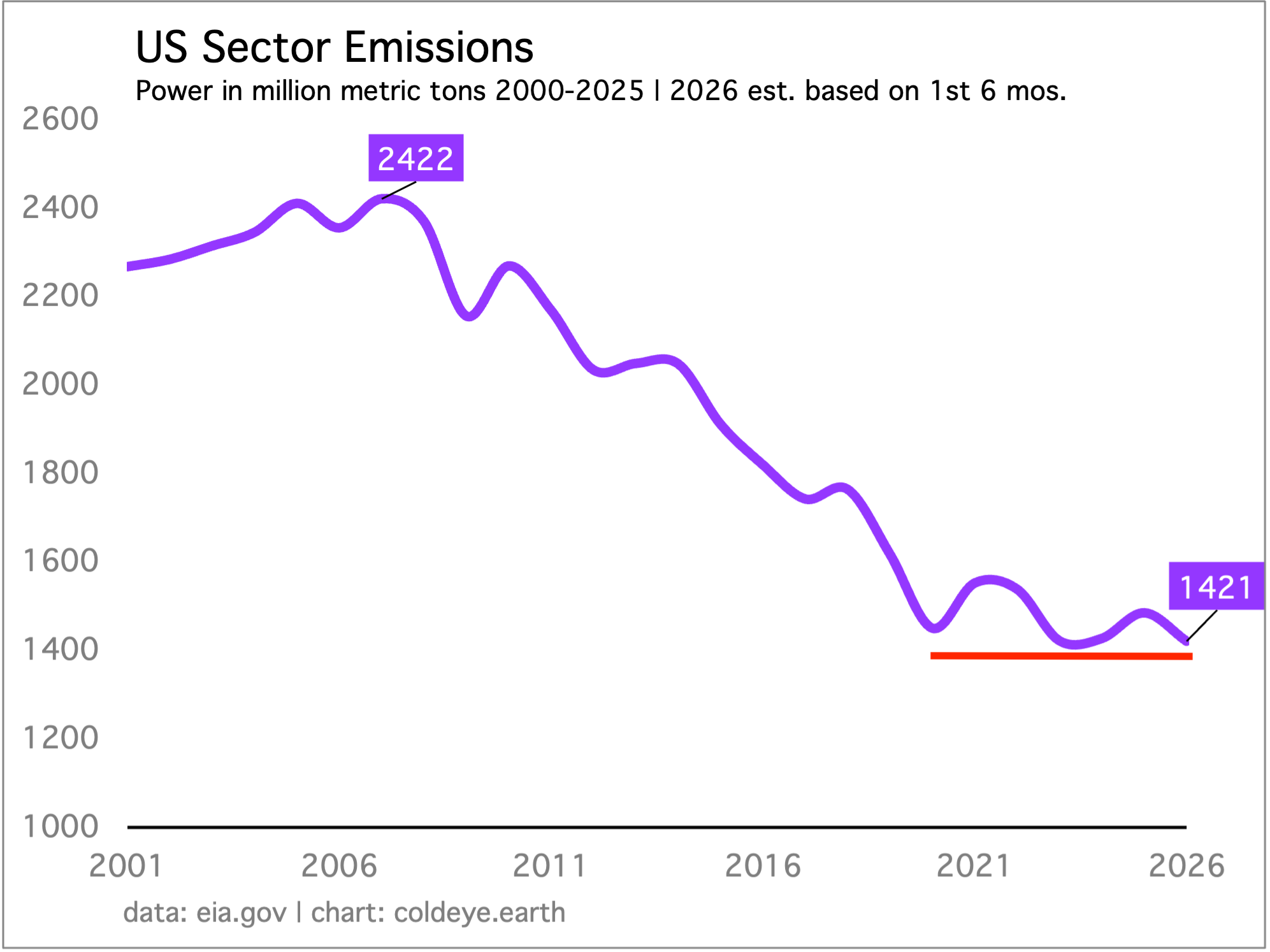
Now, the current consensus on U.S. power sector emissions is that we have entered a well-articulated decline, with more to come. Well, sure, that’s one way to interpret the chart. However, it’s been the view of Cold Eye Earth that the robust declines observed from 2005 to 2020 were a product of a rapid coal capacity retirement schedule that won’t be repeated. Yes, more coal retirements are to come; just not at the pace seen in the last decade. Accordingly, when you combine rapid growth of natural gas–fired generation to the slowing of coal retirements, there’s a very real risk that power sector emissions are currently bottoming. And, if just half of the new capacity forecast by the Earth Justice report comes to fruition, that would cause emissions to rise strongly out of that bottom. But there’s more to say about that bottom, and why it’s already forming.
For some years now, Cold Eye Earth has highlighted a broad misunderstanding about the transition from coal to a combination of natural gas and renewables in the U.S. power grid. This misunderstanding flows from two beneficial qualities offered by natural gas: (1) Emissions from nat-gas power are roughly half those of coal power. (2) Nat-gas power infrastructure greatly aids the buildout of renewables, because leading-edge nat-gas power can operate like a battery—turning on and off when needed—and that provides terrific operational support to variable renewable resources on the grid. The problem, however, is that natural gas growth has become too much of a good thing. The U.S. has already built out a new, fresh fleet of nat-gas capacity in the past 15 years—which will not retire anytime soon. So, up to a certain point, the U.S. could have ideally used natural gas as a support system for a far more aggressive buildout of wind and solar and storage. But that’s not what happened. Instead, the U.S. has now saddled itself with a new natural gas path dependency—far greater than ever before—that will aggravate decarbonization efforts for years to come.
The U.S. underperformance in global EV adoption is growing ever more stark as the rest of the world zooms forward to the electric platform. That the U.S. is the global problem child in the effort to decarbonize transport is not news. With the exception of individual states like California, the U.S. effort to promote EVs and disincentivize ICE vehicles has always been weak. Indeed, the one tool common in other domains that the U.S. has failed to call upon in recent decades is fuel taxation, which was last set a third of a century ago, in 1993. Worse, the federal tax credit for EV purchases was discontinued last year, and naturally the Trump administration has greatly slowed fuel efficiency standards for new vehicles.