

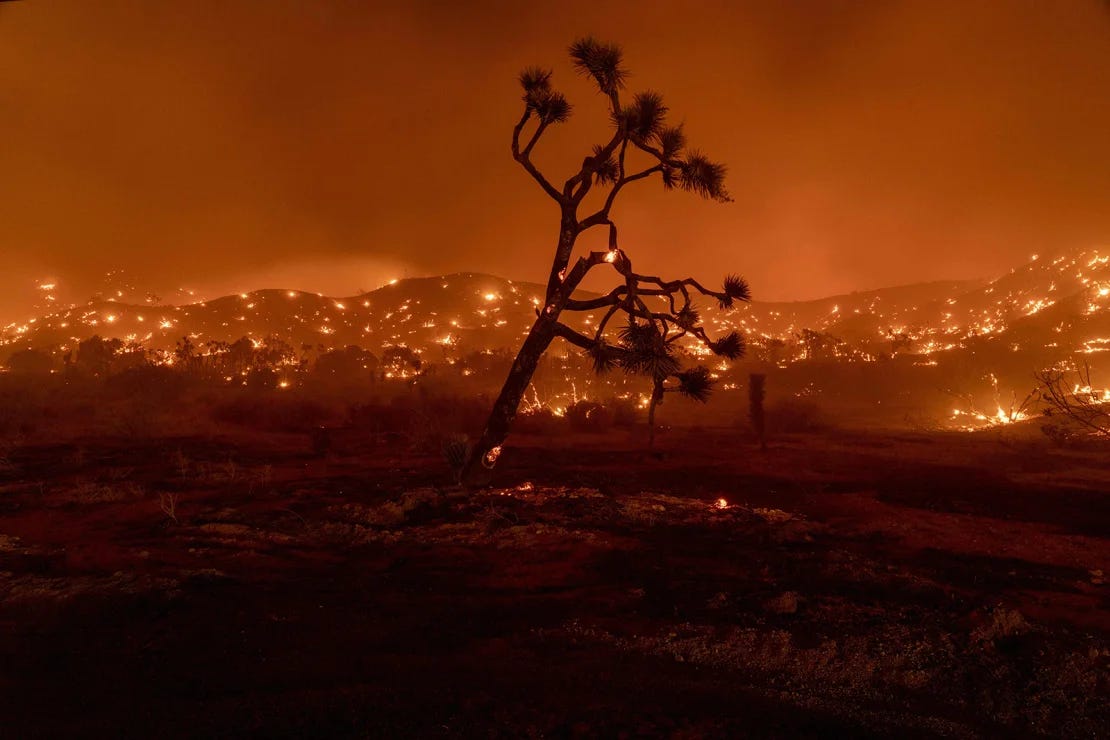
We live in a time of extreme hyperbole, when the slightest twitch is mistaken for a trend. But the devastating fires seen in Southern California this month have likely redrawn the map of the entire LA Basin—and in saying so, there is little risk of exaggeration. Both the speed and the scope of the fires were unlike anything previously seen since Los Angeles, as an American city, began its ascent over a century ago. Santa Ana winds, whipped up to speeds near 100 mph, actually came up and over the San Gabriel range this time around, entirely liberated from historical routes through the mountain passes. This exponential force drove the fires down from the hills like a tsunami, unstoppable, racing across wide roads and ignoring all barriers. Film clips of the phenomenon showed the flying of embers, darts of fire, penetrating landscapes like a spray of bullets.
The mountain ranges of the LA Basin, and the hills which lead up to them, have been a selling point for this region since the earliest days of local settlement. Advertisements in European media, meant to entice immigrants during the early 1900’s, typically showed someone holding a rose in a Pasadena backyard, with a steep hill rising in the background and a snowcapped peak just beyond. You get the idea immediately: temperate year round down at sea level, with something vaguely Swiss or Italian looking down on you from above. Pretty nice, right?
The result of the fires is that all of the hillside real estate in Southern California is going to be repriced lower. Anyone who has lived there knows that wealth and incomes correlate quite well either to proximity to the ocean, or as one goes up in elevation. Beverly Hills is a template for this phenomenon, as it contains three topographies: the flats of the downtown commercial district between Pico and Wilshire boulevards; the gently rising neighborhoods on the north side of Santa Monica Boulevard, where the real estate values really begin to take-off; and finally the canyons above, like Coldwater and Benedict canyons. In the aftermath of the Palisades and Eaton fires, which put the entire region on notice that a phase transition was now in play, the high hillside real estate that runs along the entire transverse range from Hollywood to Malibu is going to come under unrelenting pressure. This will force the market to reprice higher all real estate that’s safe from the hills. What will be the lever for that pressure? Insurance, of course.
What does it mean, for example, when people say that the majority of homeowners in the Palisades were heavily underinsured? It means that if you live in a $5 million dollar home in the hills, and over time it becomes a repository for precious artwork and furniture, that securing a full coverage policy in the marketplace is not only difficult, but gets harder each year as home values rise. We now know that this was already the case before the fires. We also know that whether in the Palisades, or the Altadena region, many homeowners were sitting on enormous, long-term capital gains on their homes—and would not be able to pay the price of admission today were they new entrants to those housing markets.
The new regime is going to see wealthy homeowners from the hills, and new entrants to the Los Angeles real estate market, begin to preference Santa Monica, Mid Wilshire, Downtown, and all the beach communities down to Orange County. If you absolutely must live in Topanga (and who wouldn’t want to live in Topanga? Your editor once lived in those magical mountains and has at times regretted ever leaving) then go ahead, build in Topanga. But you will be on your own.
How this regime change is going to affect the economy of Los Angeles is harder to parse. Los Angeles County has a higher population than at least 40 other US States. Yes, you read that right. The county is also second to only New York in its annual GDP per capita. At roughly $1.6 trillion, Los Angeles Country’s GDP accounts for about 5% of the country’s GDP. A reminder: 5% of GDP is a big deal. Over past decades, film and television production has gone fully worldwide, with shoots occurring across the global and various US states. But the business of film and television is still very much centered in L.A. As we have seen in other parts of the world, a natural disaster of this scale can also produce a small diaspora: it’s likely independent workers, of which there are many, may fan out to Idaho, Arizona, Nevada, Oregon, and Washington. Of course, it goes without saying, that forested cities like Portland—homebase of Cold Eye Earth—are also at risk in the future. Portland, Oregon for example relies on the steady drip of the region’s drizzle, which unfolds from October to May, to cross the valley of the region’s very hot and dry summer. A little secret many may not know: Portland gets less total annual rainfall than most eastern US cities. So, when you look past the narrative of Portland’s dreary gray and wet skies, the city is highly vulnerable to any withdrawal of that precipitation. Without it, Portland too would burn.
This all leads to a conclusion that most are now figuring out: as climate events bust out of long-defined ranges, no place can be regarded as a secure refuge. Hurricanes greatly disturbed the New York insurance market starting two decades ago, and now a great deal of Florida is experiencing a severe insurance affordability problem. And it must be mentioned: hurricanes and tropical storms in the US, even after moving inland and losing their punch, have wrecked regions from Vermont to western North Carolina with devastating floods. More regions will join this list.
Further reading:
The L.A. Fires Are an Epochal Economic Disaster, by Matt Zeitlin
The Insurance Crisis That Will Follow the California Fires, by Elizabeth Kolbert
Emissions declines are hard to achieve but the Golden State—which happens to be the world’s 4th largest economy—has managed to produce them. So, despite the fact that climate change is a global, not a local, problem the state of California is doing more than its share to help out. According to the California Air Resources Board, total
greenhouse gas emissions—a slightly broader accounting that goes beyond just energy-related emissions—started to fall after the Great Recession, post 2008. Since that time the state has hard charged its power system with gobs of new wind and solar, while enacting disincentives for ICE vehicles alongside a slate of measures meant to encourage EV adoption. The results below are just through 2022, but there’s no doubt the declines continued through 2023 and 2024.
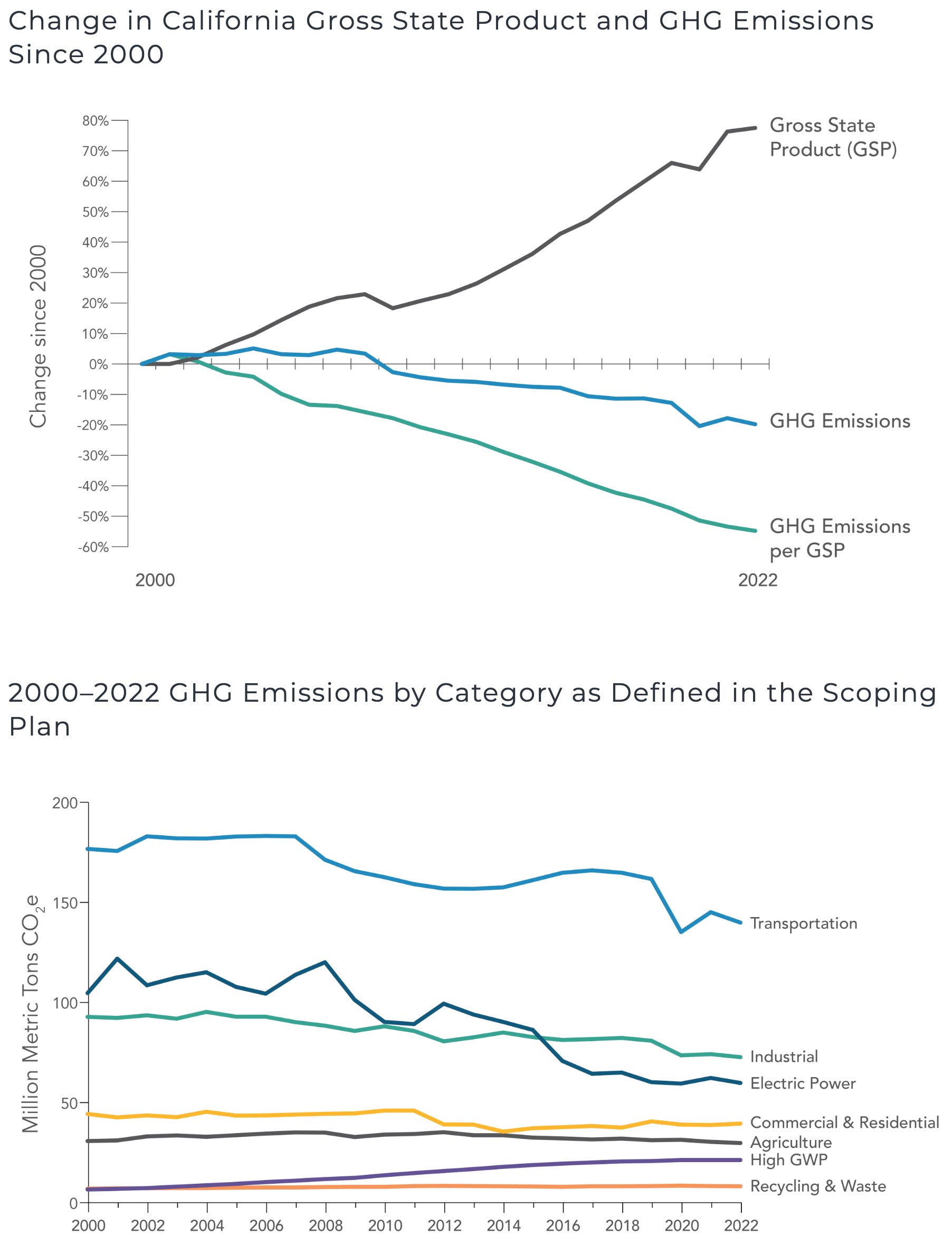
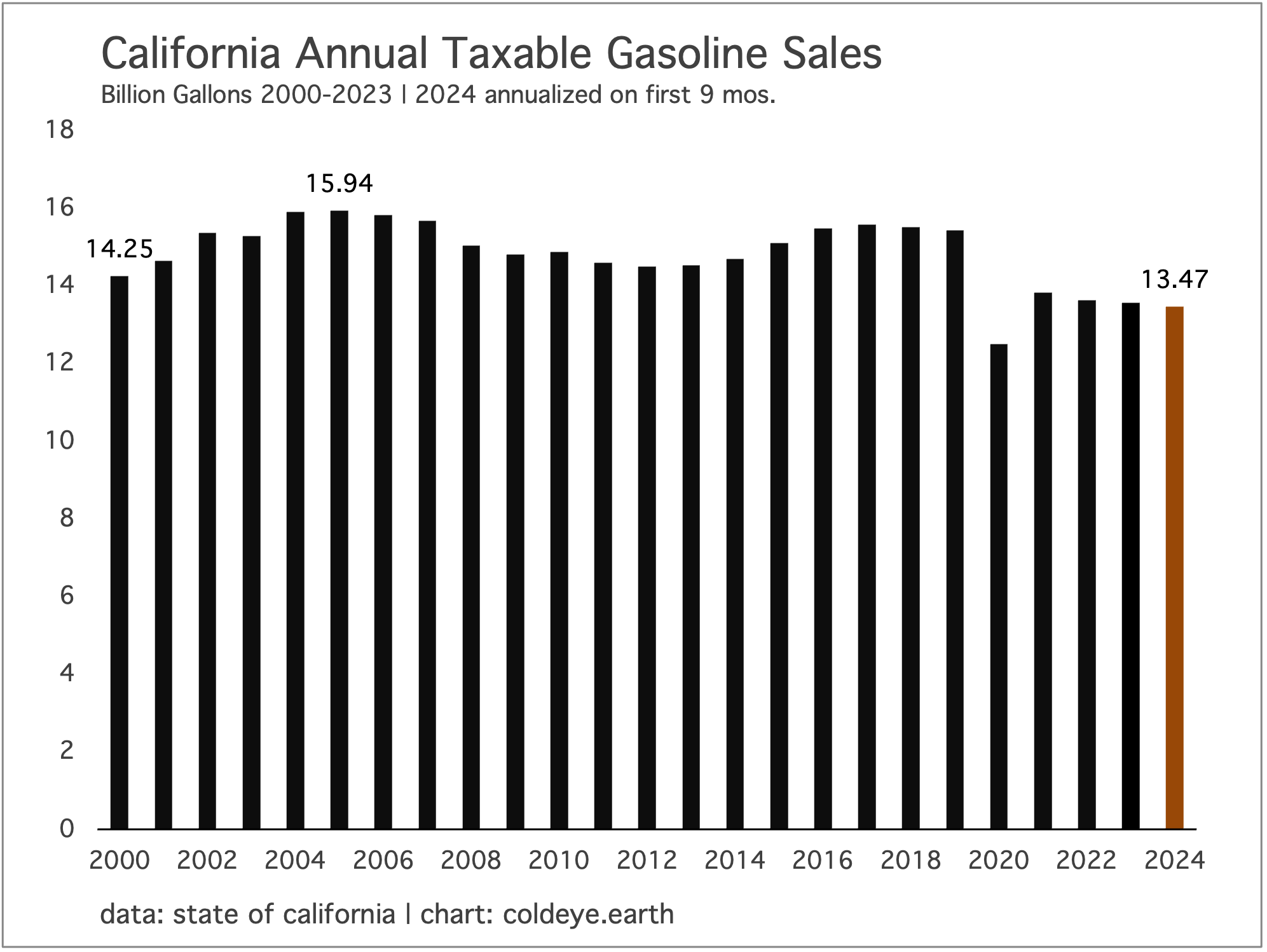
Note the lines for Transportation and Electric Power, the two areas where the biggest gains have been made. California gasoline consumption, for example, peaked before the pandemic and never fully recovered. Indeed, the peak occurred in 2017. The state’s adoption of EV has been strong of course, and along with a slight outflow of population (net migration), that has forced petrol consumption into outright decline. Not an easy thing to achieve!
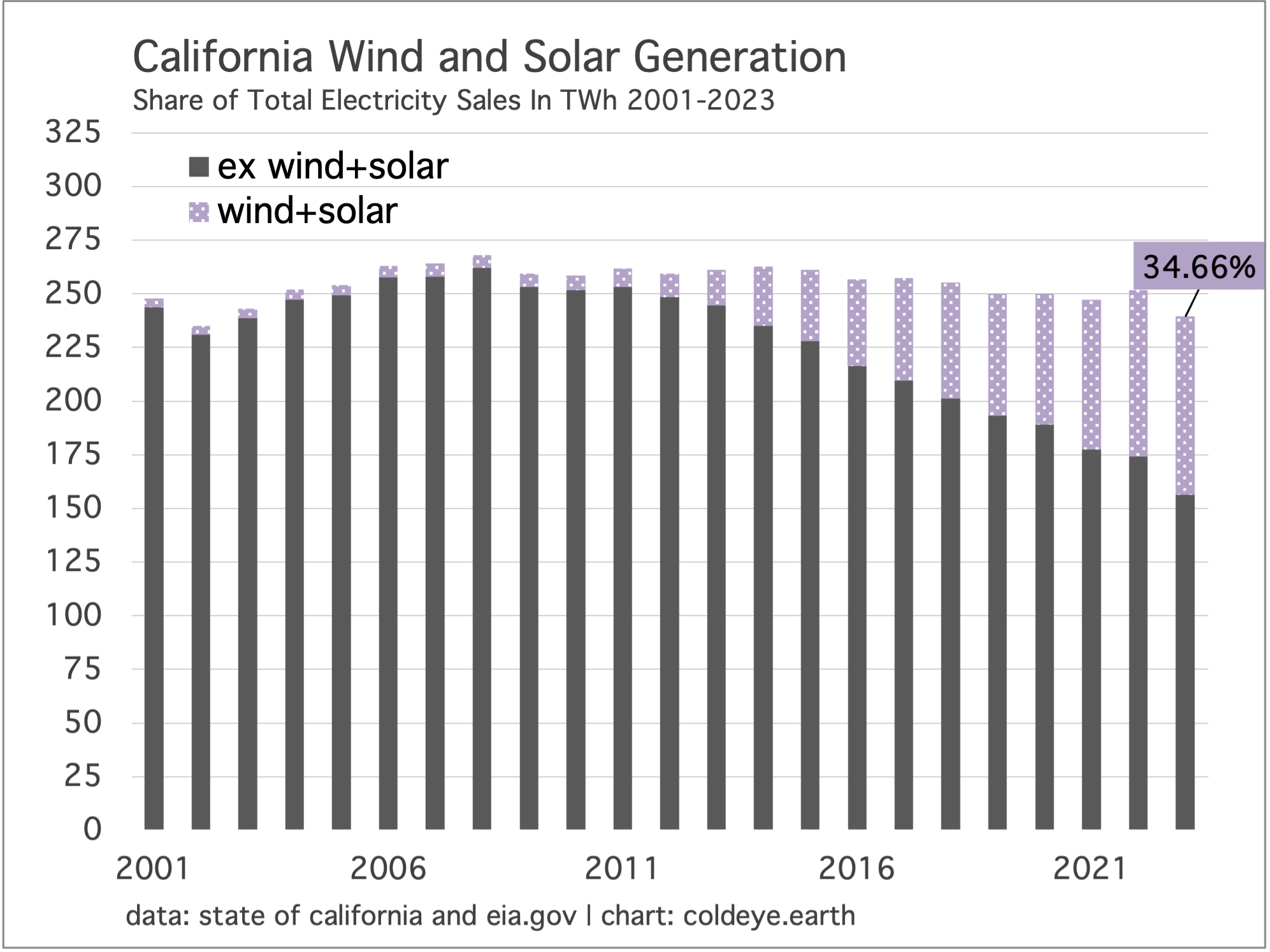
In California electricity, combined wind and solar reached 35% of electricity sales in 2023. Note especially that California is enjoying the most favorable transition conditions, in that it’s not only growing wind and solar output, but doing so at a time when total electricity consumption is gently falling. That makes for exceptionally easy progress and readers will want to remember the opposite set of conditions which the larger world continues to face: trying to grow wind and solar output as total electricity consumption continues rising, and rising strongly.
Where is California headed next? The state has already lost one congressional seat as a result of apportionment after the 2020 census. Given the myriad challenges which now face the state, forecasts show relative population dropping further, with a loss of 4 congressional seats after the 2030 apportionment. But California is going to continue building wind and solar and batteries (yes, despite this week’s fire at Moss Landing), will continue to adopt EV, and is likely to see industrial activity in-state either decline, or become cleaner. Unfortunately, the outlook for emissions in the United States as a whole is not as promising.
By the time you read today’s newsletter the incoming President, Donald Trump, is going to unleash a blizzard of executive orders that will surely slow the progress of energy transition in the US. What’s particularly frustrating about this turn of events is that the US was not on a particularly encouraging path even prior to Biden’s election day loss. National emissions were essentially the same in 2024 as they were in 2023, and importantly, there was no catalyst in the pipeline to force meaningful declines by 2030. Among the rumored executive orders to come this week: a pause on all offshore wind leasing; removal of drilling restrictions on public lands; and a withdrawal from the Paris Accord. Let’s also throw in a big dent to regulation around emissions standards, in everything from vehicles to the construction of new public buildings.
The Environmental Protection Agency must have been feeling defiantly optimistic however because in just the past week it released its latest Net Greenhouse Gas Emissions Projections and forecasts that energy-related emissions are on course to fall at least 40% from the 2005 baseline by 2030. To get readers oriented to the math, energy-related emissions stood at 6000 Mt in 2005, and would need to fall to 3600 Mt by 2030 to hit the minimum of EPA’s target. Where are energy-related emissions today? At 4775 Mt. Well, gosh. Sorry, there is no way the US is going to shed 1175 Mt starting this month, and running into the year 2030. That is a bad forecast, and when government agencies make bad forecasts it’s downright unhelpful.
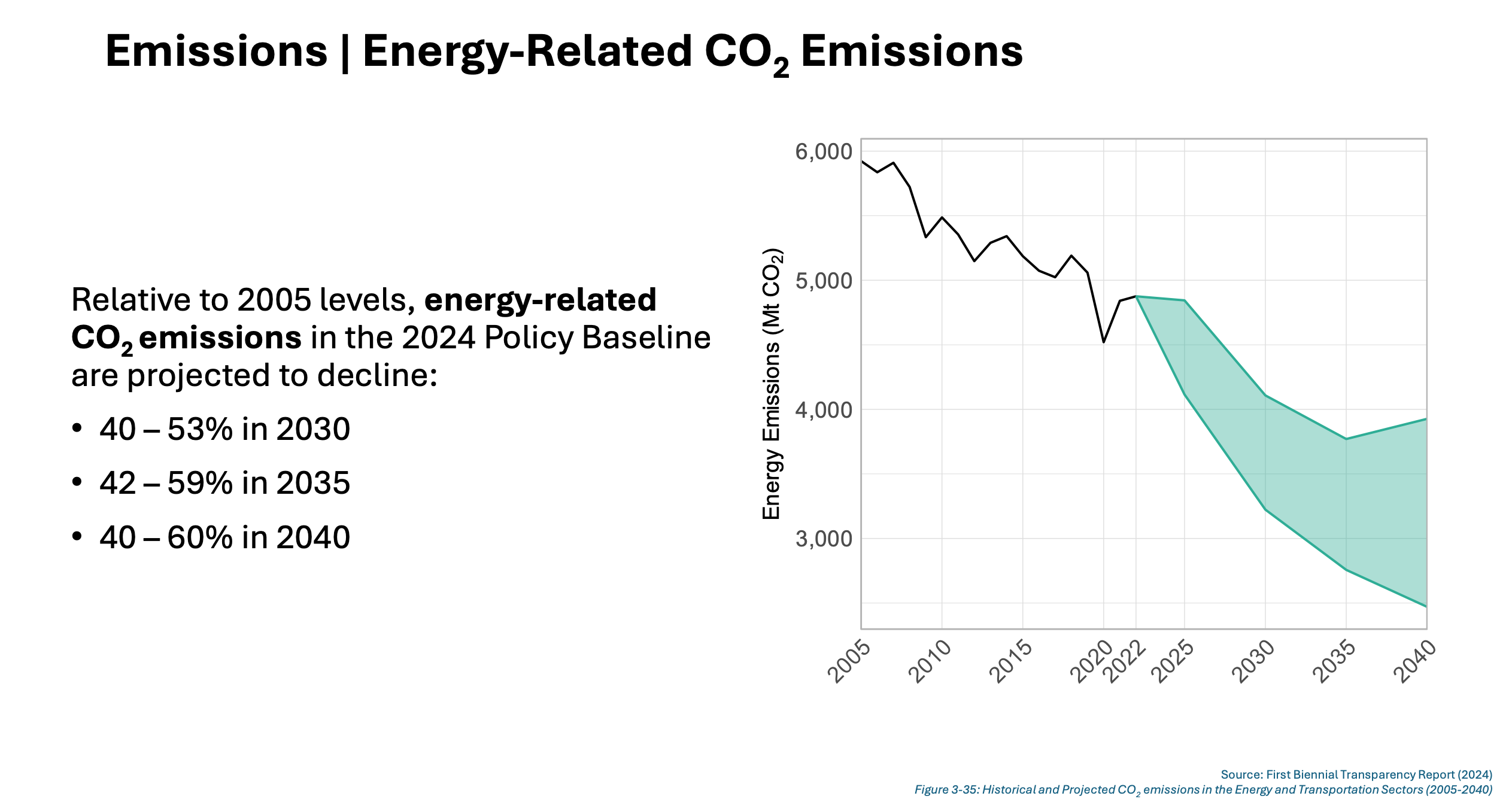
Worse, as you can see, EPA has a high side projection that energy-related emissions could fall by as much as 53% by the year 2030! Leaving that aside, let’s consider how incredibly hard it would be to shed enough tonnes of CO2 output just to reach the EPA’s “easier” reduction target of 3600 Mt. Using the historical chart will help:
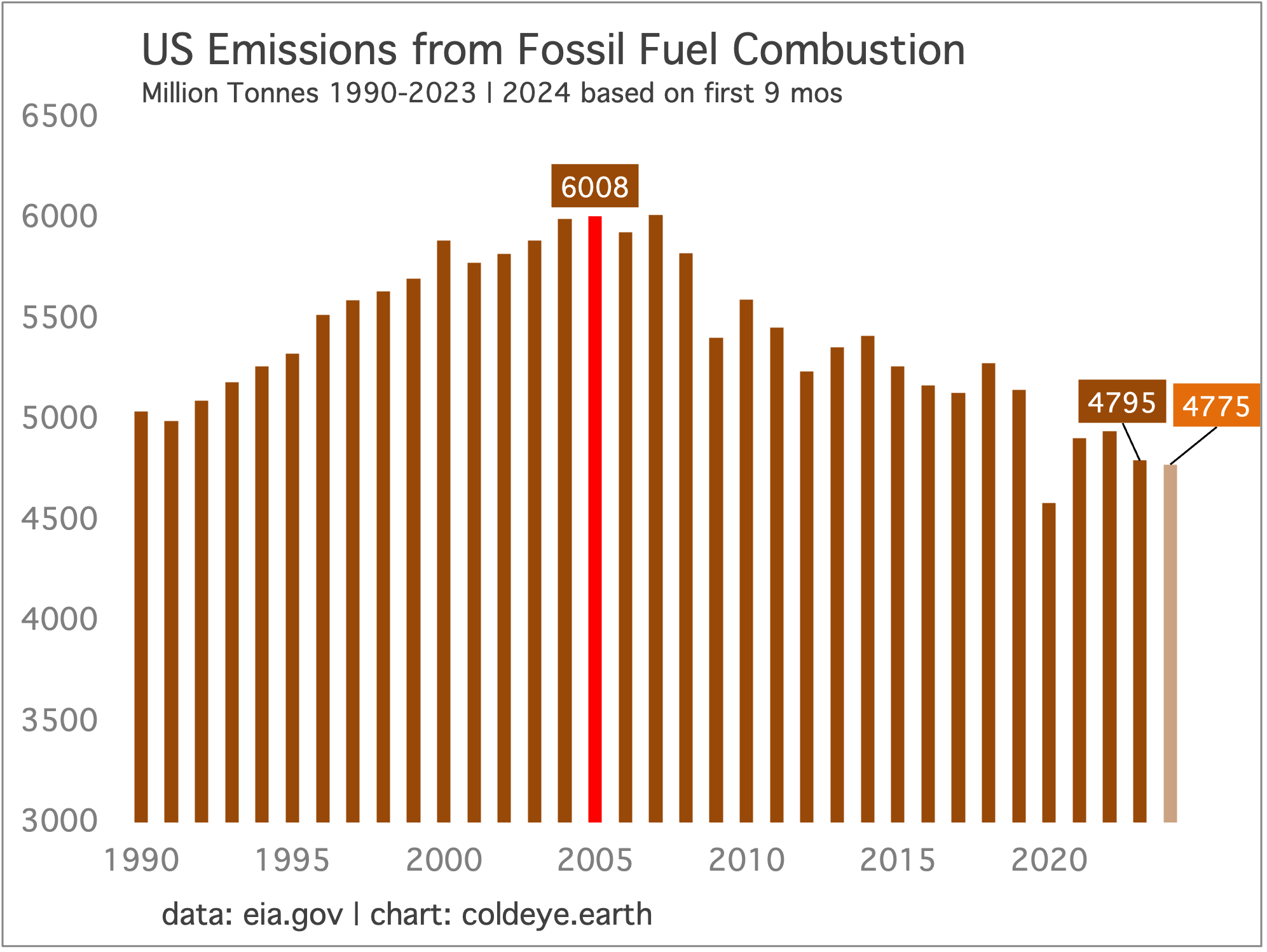
To reach the EPA’s 3600 Mt target, US energy-related emissions would need to fall, on average, by 235 Mt per year the next five years (4775 - 3600 = 1175/5). Big problem: those declines are of a size rarely seen in the past twenty years. Indeed, only during the Great Recession of 2008 -2009, the near-recession of 2011 and 2012, and the pandemic year, did emissions fall by such large volumes.
Cold Eye Earth forecasts that emissions will indeed fall some more, by 2030. But it’s absolutely not possible to forecast by how much, given the extreme policy uncertainty that we’ll experience the next 4 years. Other blow-back or revenge effects could enter into the scene as well, paradoxically leading to some declines that counter the intentions of Trump policies. For example, states like MA, NY, CA, OR, WA, and IL could get very aggressive on a range of initiatives. Here’s a wild thought: if congestion pricing was politically difficult when Democrats were in power, because they would be the incumbent party blamed for those inconveniences, then under a Republican regime congestion charges could be a way to “fight the President.” Just to note: no state has the authority to introduce congestion charges on a federal highway, but look at New York City: their congestion zone doesn’t impinge on federal roads. Boston, Portland, Seattle and Chicago could all impose similar zones in their respective downtowns.
All this said, the likeliest outcome is that the next 4 years will push the EPA’s forecast even further away from its current targets, and one easy revision to apply here would be to simply move all the EPA’s goalposts out five years.
Direct link to EPA document in PDF form.
• News Briefs • The New York state supreme court dismissed a climate case brought by the City of New York against major oil companies. • Insurance premiums for vehicle owners, while still higher than years ago, have begun to soften in the UK after lower speed limits led to fewer accidents. • The new congestion-zone in New York City has been a spectacular success, making life easier for pedestrians, converting former critics to advocates, and reducing travel times for all who must drive into lower Manhattan. • Goldman Sachs is already using new AI tools to reduce the time needed to produce regulation filings, leaving just 5% of the work for humans in finalization. • Boycotts of Tesla vehicles are appearing in Germany, where managers of fleet electrification programs are electing to avoid the brand as a result of Musk’s intrusion into continental politics. • In new randomized trials, the use of GPT-4 as a tutor in Nigeria has been found to outperform 80% of other interventions.
—Gregor Macdonald