

Financial crises tend to burn themselves into the psyche of nations. The South Sea Bubble, Tulip mania, the Crash of 1929, the German hyperinflation of 1930’s, and the Asian Financial Crisis of 1997 are just few examples of market dramas that inevitably shaped future monetary policies, market structures and each nation’s perception of risk. The traumas need not be restricted to markets. China’s multiple, historical famines—in addition to the 20th century Great Chinese Famine—have created, according to some scholars, a kind of hard, red line around food security. A study at Berkeley in fact showed that the last famine continues to have negative impacts on people’s health. The first job of any Chinese government, it’s been said, is to entirely foreclose upon the risk of starvation.
The ghost of a past trauma that clearly animates current thinking around the AI investment boom is of course the Dot Com bubble—an exuberant, deflationary growth event that caused the U.S. to understandably conclude it was ground-zero for tech futurism, and that this cornucopia of progress would press onward, well, “forever?” While a tremendous volume of crucial internet infrastructure was indeed deployed through that mania—foundational to today’s far more advanced capabilities—the bubble was ultimately humiliating, and wound up wrecking the careers of many people who both successfully, and then unsuccessfully, rode that wave. On a more humorous note, “Dot Com” finally replaced the 1929 crash as the go-to model for traders seeking a template to guide them through a historic market meltdown.
Which brings us to today: there is currently a feverish model-making community attempting to build a road-map for how and when the current tech-driven bull market will end—as they all must end—in tears. If you haven’t been following along, the AI bull market has, so far, deputized a number of sectors already from semiconductors to electrical utility and power, and more recently to optics and computer memory makers. Unsurprisingly, the various Magnificent Seven names have participated in their various ways, from the concentrated bet expressed through Nvidia, to the AI focused Google, and to other hyperscalers trying to find their footing like Microsoft to Meta, and Amazon. For the modelers of the coming bust, the imminent initial public offerings of SpaceX, Anthropic, and Open AI are classic over-the-bow warning shots that we are entering the final stages of the current AI bull run, or at least, “we are much closer to the end, than the beginning.”
Mostly though, the roadmap currently in favor among the bubble watchers overlays two time series: The number of days (or weeks, or months) which passed from the introduction of the Netscape browser in 1994/1995 to the top of the market in 1999/2000 vs. the number of days which have passed since Open AI introduced ChatGPT in 2022, through today. Some use the Nasdaq 100, or the Nasdaq composite, or even the SP500 as their market measure. In the version below, which comes from Fidelity, the chartmaker is using the Inter@ctive Week Internet Index, and finds that were the current market to match Dot Com, the bull run would top out later this year.
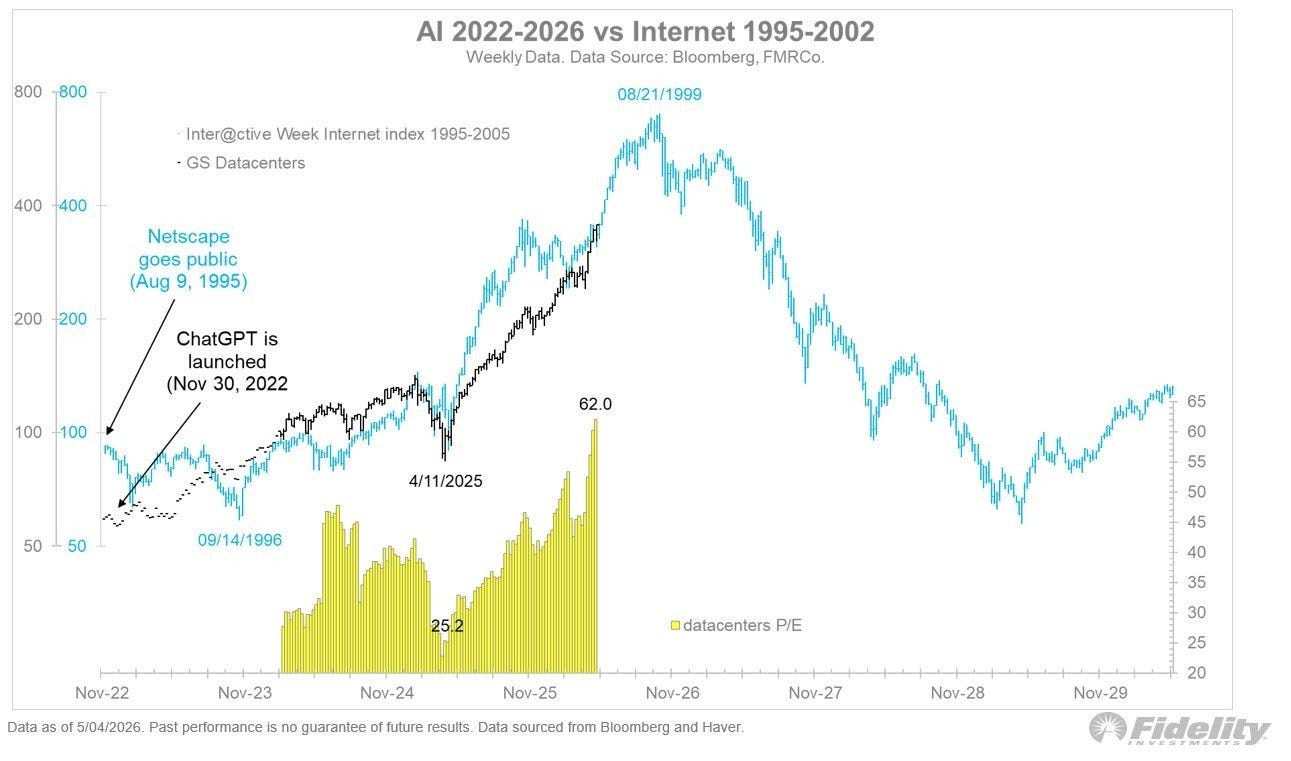
But here is another variation, this time from Bespoke, that anchors Netscape to late 1994 and uses the much broader Nasdaq composite index. Following this particular historical roadmap suggests the current AI driven bull market has almost another two years to run.

Wise investors will generally take note of these models, and then proceed to not rely on them. In other words, these charts function best as starting points for your own thinking, your own analyses and your risk management. Here, we must pay some due to Nassim Taleb, who insightfully pointed out that humans are so desperate for maps to guide them that they will happily take the wrong map and use it anyway, if it makes them feel better. While we know that all bubbles end in a bust, it’s not clear that the Dot Com era is the best fit for the current one. Cold Eye Earth has a slightly different map, therefore. After all, the goal of this game is to not get fooled again, right? Read on.