


An emerging bright spot in our current energy transition is that global road fuel demand appears to be peaking. Here at Cold Eye Earth we maintain a healthy skepticism towards any claim of a peak in fossil fuel demand or emissions globally, and equally assert that these declarations can neither be reliably “called” in real time. Peak declarations have scurried about for nearly twenty years now, nearly all of them wrong. But at least in the past, the “peak game” in energy demand forecasting paid respect to a time-window, in a nod to uncertainty. Today’s peak callers rush to the stage after quarterly data to yell “peak” only to throw themselves against this wall repeatedly as the years pass by.
The prospect that global road fuel is currently in the midst of peaking is composed of a number of data points, but owes most of its viability to long-run trends that began a decade or more ago. Put another way, the very same trajectories that got people excited about a peak in oil demand were overly embraced when they first appeared. Those trends needed time—and lots of it— to broaden and deepen. Let’s take a look at them.
• The arrival of the first EVs, and the array of incentives to buy them, 2005-2015. We can think of this period as the early investment phase, the start of a long journey that would eventually curb sales of internal combustion engine (ICE) vehicles. Europe and the U.S. were the first participants in this stage which had no effect at all on oil demand but prepared the ground for an eventual shift. A great example of how this lengthy return on investment played out in a specific domain is California, which remains the leading edge market for EV sales in the U.S. The seeds were sown. And eventually, they bloomed.
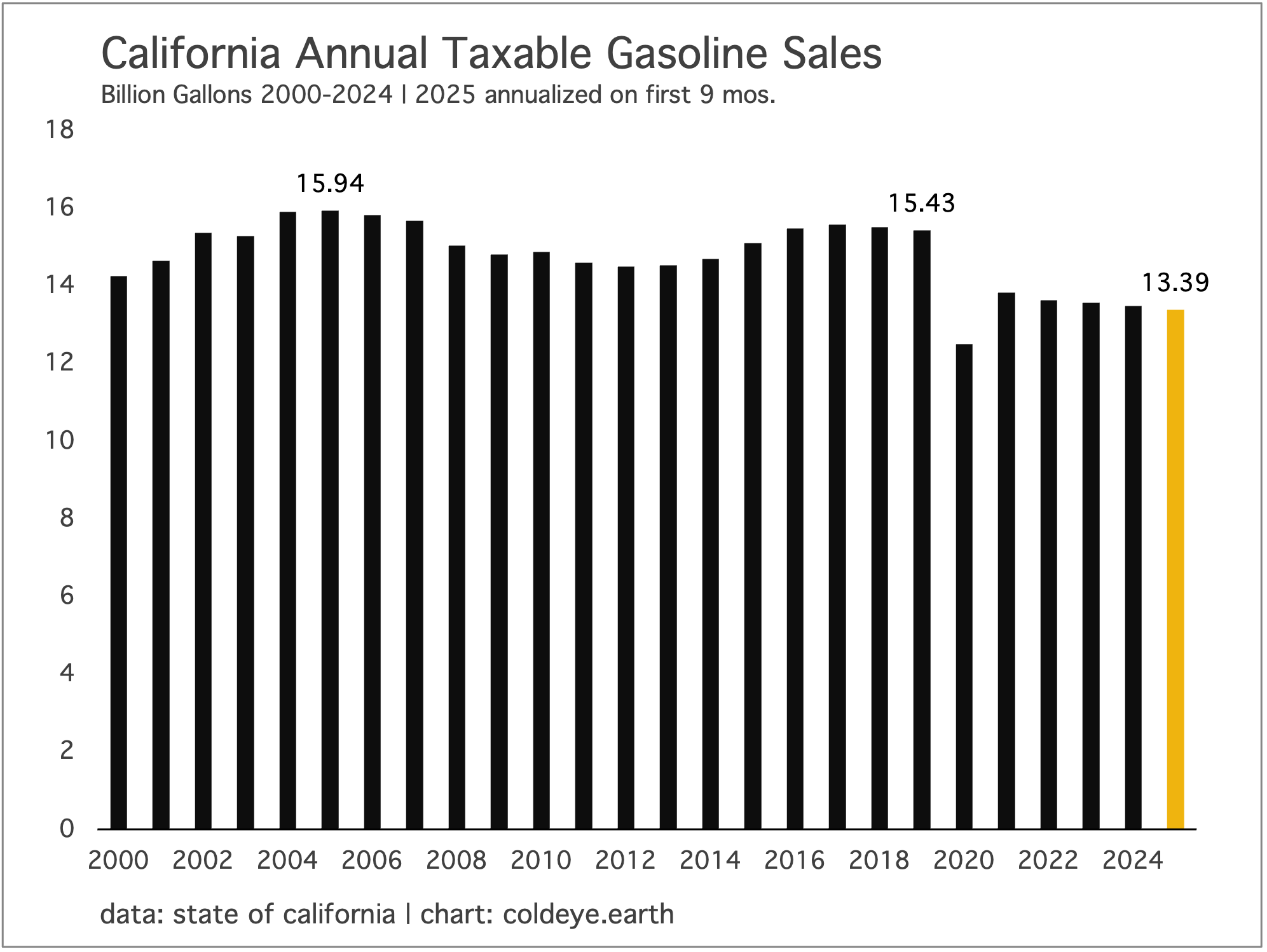
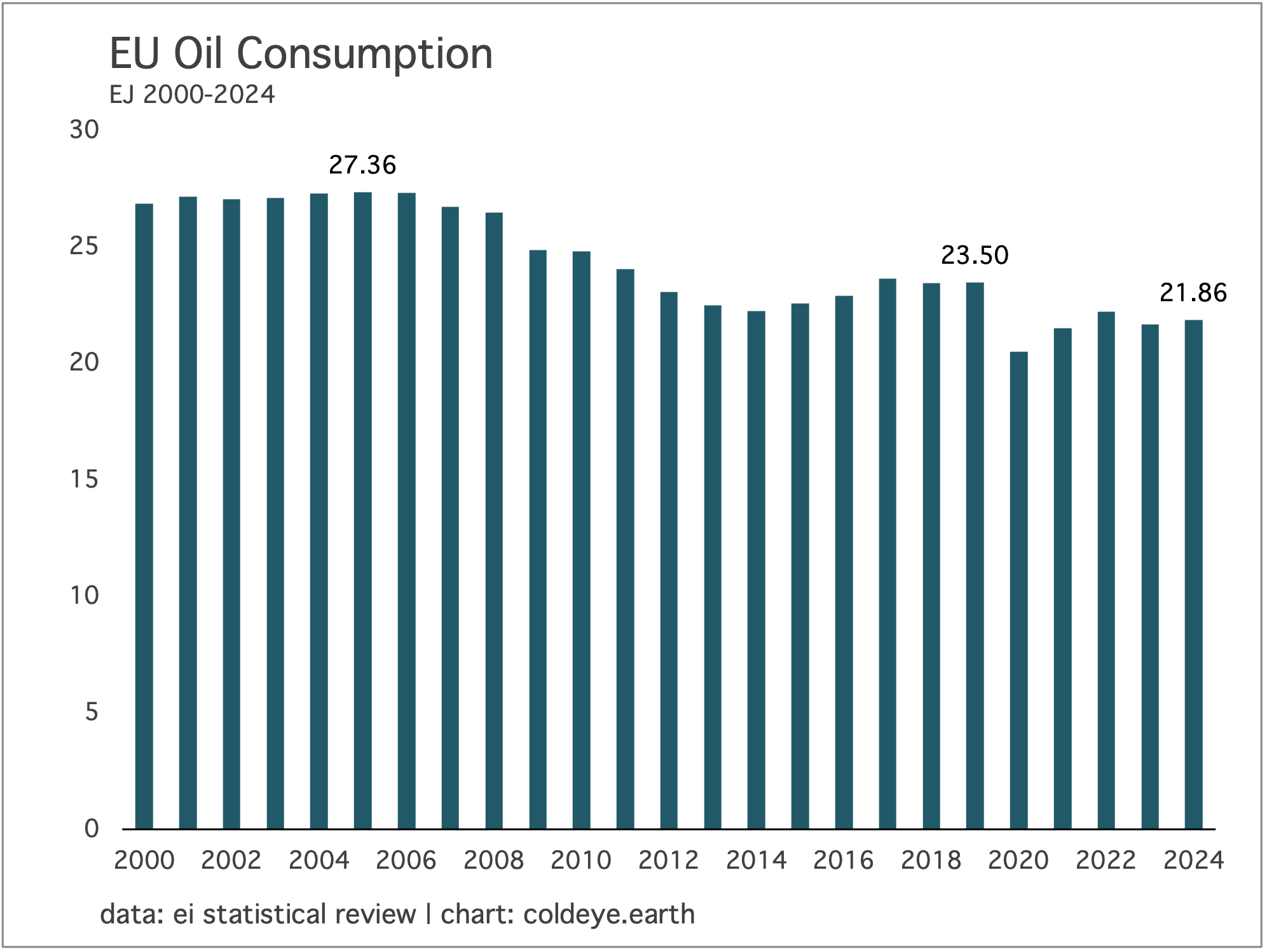
• Disincentives to ICE vehicle ownership in the form of fees, higher petrol taxation; the rise of the walkable city and the flowering of emissions zoning and congestion pricing; and the exploding popularity of EVs, 2010-2020. Although adoption of EV in the U.S. during this period was sluggish, (and remains so) globally the car itself became an increasingly powerful symbol of the problem of climate change. Europe, for example, had long been a leader in ICE disincentives—mostly through stiff petrol taxes—but then cities from Paris to London to Barcelona began a second initiative to attack ICE vehicles through travel fees, and car zoning. Just as in California, those initiatives accumulated over time and then broke through.
• The juggernaut of China’s EV-forward transportation policy, and the peaking of global ICE vehicle sales, 2015-2025. In the year or two after 2018 we began to safely conclude that global ICE sales had peaked, as they were unlikely to turn around or recover again given global sales growth of EV, especially in China. What we did not know is how rapid and aggressive (see the chart below) the ensuing 5-7 years would become for EV sales in China, as they stormed both passenger and commercial markets. The best estimate for EV sales last year (based on 11 months of data) is that they got close to reaching 50% of China’s total market. This means it’s an easy layup to project that EVs will push past 50% of the market this year. Put another way, the ICE vehicle, in China at least, just became the rotary phone.
Now, to take the next steps to a thesis of peaking global road fuel demand we need to understand that China has largely driven global oil demand higher for years, despite ongoing declines of oil consumption in the OECD. It may seem obvious to say so, but without China’s demand growth global oil demand would have peaked by now—which is to say that when China’s oil demand peaks, it makes it very hard (nearly impossible) for the rest of the world to take oil to a new higher level. Why should we speculate now, however, that this inflection point has been reached? Let’s consider the following:
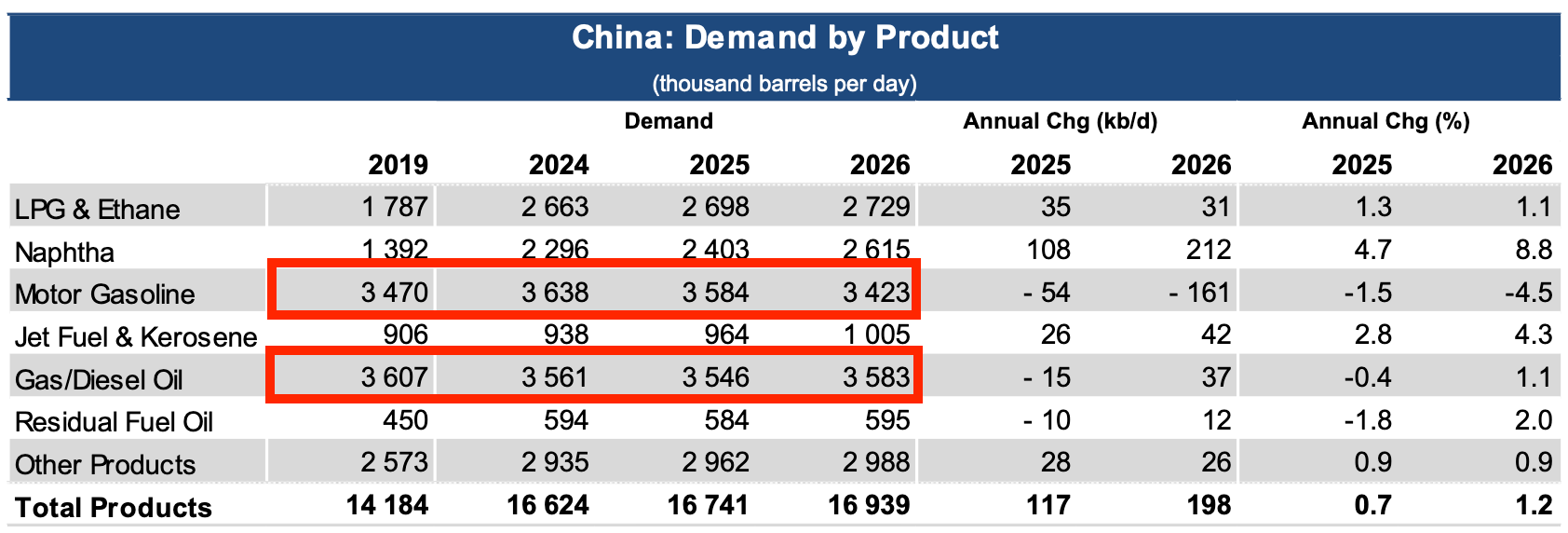
Data from the IEA now shows that road fuel demand in China is flattening out. The IEA tracks both gasoline and gas/diesel oil, and incredibly both have failed to grow for a couple years now, and are projected to (not) grow again this year. Furthermore, it seems quite notable statistically that 2026 gasoline demand is no greater than it was in 2019, and the same is true for gas/diesel oil. The chart below is from the December 2025 Oil Market Report:

China’s oil demand actually fell in 2024 by 1.7%. As always, one cannot make a trend from a single data point. But we have not seen China’s oil demand fall even once this century, until last year. Not during the global financial crisis. Not during COVID, either. Yes, demand slowed during those periods, but still grew. Another indication: From 2021-2022 China’s oil demand barely grew at all.

Further growth in global road fuel demand has a new opponent and that is affordability. You will have noticed in each of the charts just presented that there’s also a kind of dropoff that’s seen across each data series after the pandemic year, 2020. Here, it’s not 2020 itself that interests us but the way in which gasoline sales in California, oil consumption in Europe, and EV sales in China lurch notably after the pandemic. We need to consider the strong possibility that, through a combination of disrupted purchasing power from inflation, high sticker prices for new cars, and the cost of insurance and maintenance, purchasing a car has become a far more daunting prospect. Now add to this the common knowledge that young people across the world feel that housing and living costs are already burdensome, and that leaves little to nothing left over to handle the purchase of a car. In the U.S., the average price of a car hit another new all time high last year, and this trend looks unstoppable. Indeed, one wonders that the fate of personal vehicle ownership is to become somewhat of a luxury item, supported by upper income consumers. Should this happen, the conclusion is not hard: the inventory of vehicles on the road will shift upward in price, and thus the total stock of vehicles will stagnate, and then slowly decline.
It’s riveting, to say the least, to witness so many constraints raining down on oil demand when oil itself is at twenty-year, inflation adjusted lows. Clearly, the low cost of petrol cannot outrun the high cost of vehicle ownership. Indeed, all fossil fuels are incredibly cheap these days and have been cheap for a while. The price of natural gas or coal almost seem trivial now compared to the incredible increases in construction costs, maintenance, and operational expenses of building new power plants. While applying Baumol’s Cost Disease (or Effect) doesn’t seem to fit easily into this equation, you get the idea: deflation in one part of the economy can free up purchasing power that lands in some other part of the economy, pushing prices upward. Natural gas in the U.S. has to be one of cheapest fossil fuels in the world on a price-to-BTU basis, for example, and it drives the bulk of U.S. power generation. Yet, household electricity bills never stop rising because the infrastructure and labor costs to maintain the grid totally overwhelm the energy-cost to produce that electricity, rendering the price of natural gas a trivial afterthought. To make this point plain: imagine if every energy source was priced at zero—what do you think would happen to all the costs associated with delivery of that energy, to you?
It’s highly likely that the affordability problem for vehicles is of course now expressing itself in the U.S. As you can see, U.S. gasoline demand has been oscillating for two decades, but in conformity with most of the other data series, it couldn’t recover after the pandemic year. And now, in 2025, it’s starting to decline.
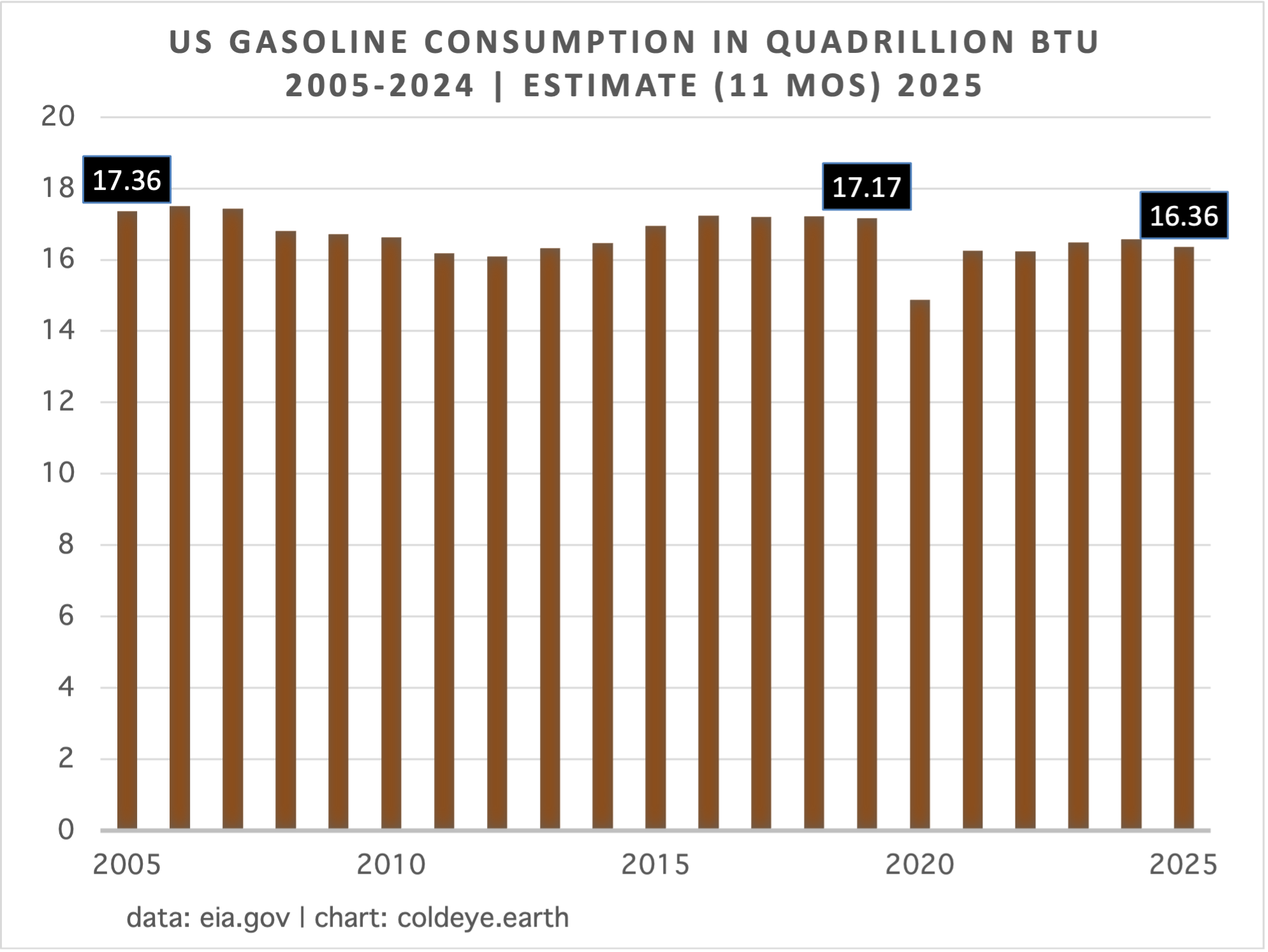
Was the U.S. economy weak last year? No, it was not. But gasoline consumption fell from that lower plateau anyway. While it’s certainly not the case that U.S. gasoline consumption is about to enter a steep decline, there’s nothing the U.S. can do to help out now with global road fuel demand. And yes, car purchases among young people age 18-34 is falling as you might expect.

Oil consumption is not likely to add much to global emissions growth in the years ahead. That feels like a momentous statement to make, but unless there’s a massive and sustained technological setback or reshaping of the world order that renews a big call on oil, it’s no longer clear where the demand will come from to get us to successive new highs in consumption. Yes, oil has other applications (as do natural gas liquids) but the downward force right now is clearly brewing in the transportation sector, which accounts for roughly 60% of total global oil demand. Petrochemicals, plastics, and other applications for oil are simply not capable of counteracting the trend in transportation. And the current price of oil, as it’s been sustained at these low levels for some time now, is likely reflecting all these factors.
—Gregor Macdonald