


Crafting a working description of our current energy transition continues to be a challenge. We remain stuck in a version of the classic Dickens novel, A Tale of Two Cities, in which it’s seemingly the best of times for the continued buildout of wind, solar, and batteries while we are forced to endure the worst of times when it comes to emissions, which keep on growing. A recent editorial piece in the New York Times by David Wallace-Welles, Don’t Look Now, but the Green Transition Is Still Happening, illustrates the challenge perfectly. And the problems start right away, with the title, which depends greatly on how one defines transition.
Is our current energy transition one in which old forms of fossil energy are being replaced by low carbon sources of energy? Not really. A more accurate description would be that energy transition has gone far enough to see low carbon energy dominate marginal demand growth—thus halting new growth of fossil energy—while leaving all the existing fossil energy demand, unfortunately, in place. The structure of Wallace-Wells’ essay is a familiar one, in which you kick off the argument with an extensive list of stellar low carbon achievements: This January, Norway sold only 7 vehicles with an internal combustion engine; Pakistan now sometimes produces more electricity from rooftop solar than from its main power grid; 90% of new U.S. power capacity is composed of wind and solar. And so on.
Regular readers of climate journalism will recognize this touting of achievements and the declarations are well deserved. Cold Eye Earth feels obligated to cite these wins also, and just recently took the view that global road fuel demand has almost certainly peaked, because EV adoption in China has finally reached critical mass, closing the door on global road fuel demand going much higher. So again, there is no shortage of good news items, but the bigger picture is not great. And presumably, no one reading this is confused about the fact that the bigger picture is the only one that matters. Thus, starting about half way through Wallace-Well’s essay, we get the other half of the story:
New power changes the existing system only on the margins, and the old system is pretty dirty. To this point, new green energy has mostly supplemented rather than displaced fossil fuels. Globally, emissions are still climbing, if slowly, and temperatures are not only rising but rising at an accelerating rate, raising the uncomfortable possibility that the world’s climate system may be more sensitive to emissions than almost anyone had bargained for.
So, in the title, we have the claim that the transition is still happening, but in the body we get the admission that low carbon energy has mostly supplemented, not replaced, fossil fuels. Doesn’t sound like an actual transition, does it? Effectively, the headline claim is undermined by the facts and you do have to wonder how long this storytelling architecture can sustain itself before reaching full burnout. At its worst, this format preys upon common human intuitions that if lots of good news is being generated that it invariably leads to a great outcome.
Wind and solar once again covered all the growth in U.S. power generation last year. But power sector emissions rose anyway. The culprit? A huge spike in coal-fired power generation. Here we have a truly unfortunate example of how renewables can meet all marginal demand growth, but a change in composition of fossil fuel utilization (coal took back some share from natural gas) allows emissions growth to find a way upward. Let’s take this counterpoint to energy transition in two parts.
First, the U.S. is a major world domain for wind, solar, and battery growth. Last year, wind and solar reached a nearly 19% share of total U.S. power generation. 2025 was also the sixth year in a row that wind and solar have basically covered all marginal growth in power sector demand growth. You can see that marginal coverage quite easily, just by glancing at the following chart:
This chart is a portrait of additionality, the much criticized term that makes the simple and direct observation (just as Wallace-Wells acknowledged) that energy transition so far is merely supplemental to the world of fossil fuels. Is it a victory to have at least halted the growth of fossil fuels—as demonstrated here, in the U.S. power sector? Indeed it is a victory. However, the reason why renewables are competitive for new build power and less so against incumbent power—both in the U.S. and around the world—is due to simple economics: renewables are cheap, but they are not dirt cheap. The former gets you wins in the marketplace for new capacity. But the latter doesn’t get you radical disruption to existing capacity.
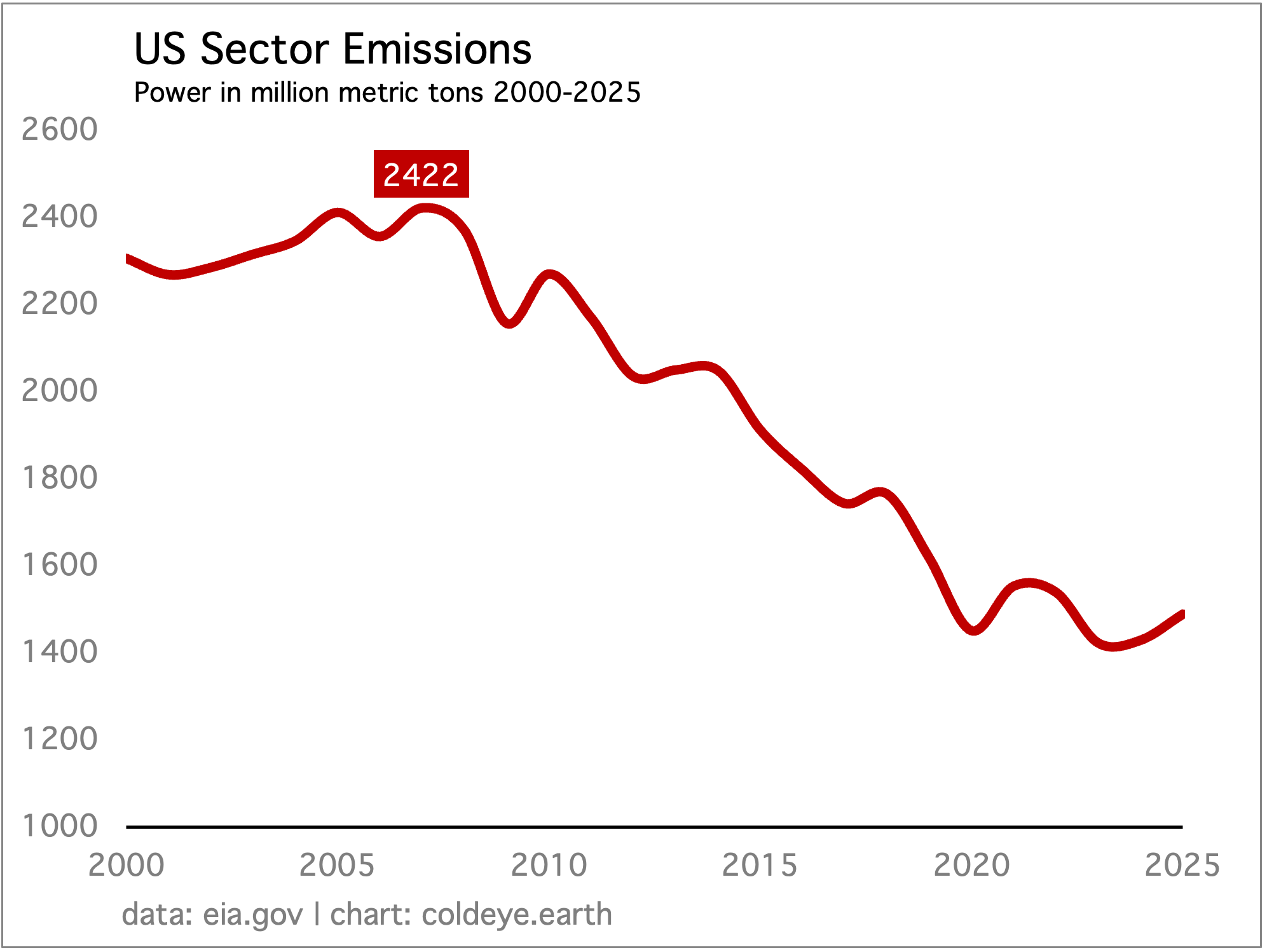
Second, power sector emissions actually rose last year. Coal stormed back into the power sector, causing emissions to rise by 4.2%. There is no question that the transition from coal to a combination of natural gas and renewables has been successful at driving a huge volume of coal out of the system. But the U.S. like many other regions in the world still has extensive coal-fired capacity that can be brought on when needed.
When spare capacity in global oil producers either expands or sits at comforting levels, oil prices have a very difficult time sustaining high levels. This is the regime we’ve inhabited for the past few years in the aftermath of the 2022 Russian invasion of Ukraine, and the associated sanctions which greatly disrupted global oil and natural gas markets.