


An exceedingly strong year for combined wind and solar growth in 2025 has created a substantial baseline challenge for continued growth in 2026. Accordingly, global wind and solar growth rates—whether measured by capacity or by generation—are now on course to pull back in 2026. The slowdown in wind growth is more mild when compared with solar’s growth. That hurts, because annual global wind growth rates are typically much lower, in the 10%–15% range, and solar is typically much higher, in the 25%–30% range.
These baseline effects are pretty routine, and we see them all the time across various domains. A typical example: the fluctuations in corporate earnings—when a company will be hard-pressed to repeat the performance of an anomalously rich year for profits. While there’s nothing that suggests a new phase of decline is underway in global wind and solar growth (after all, 2025 growth was seriously impressive), it’s still a bit disappointing that combined wind and solar will be unable to reach even higher this year. Remember, the world needs combined wind and solar to not only grow fast enough to cover total marginal growth in global electricity demand, but to grow beyond marginal demand to eat into the existing fossil-fuel underlayer. It looks as though 2026 won’t be much help in that ongoing project.
According to estimates, the 2026 pullback in growth is largely driven by China. How could it be otherwise? China has been the prime mover in global wind and solar for a while now, and accordingly it is typically the driver behind both overperformance and, now, underperformance. But it is worth considering some associated explanations for the slowdown that may go beyond China. For example, BNEF’s Jenny Chase asserted last month that we may be seeing “the end of the beginning of the age of cheap solar.” While module prices may be up only a modest amount, says Chase, this may be causing a ripple. Put another way, when markets bottom (in this case, very cheap solar prices), they tend to lift off that bottom, creating a floor.
Here at Cold Eye Earth we use an absurdly simple and quite unsophisticated model to forecast combined wind and solar generation growth each year. As discussed in the July 13, 2026, issue, Layers, the model takes the trailing five-year growth rate and applies it to the following year. No research, no polling, no phone calls to industry representatives, no costs. Quite surprisingly, the model has worked pretty well for some time, typically limited to a 5% margin of error. But this record of success ran into trouble last year, when growth exceeded the forecast by a much larger 9%. Oh well, you get what you pay for.
Last year’s growth was so strong that the model had to substantially lift the trailing five-year growth rate. From the July 13, 2026, issue:
Because of wind and solar’s great year in 2025, the trailing five-year growth rate now lifts from a previous 16.8% to a current 17.6%. That’s great! When we apply this higher rate to last year’s level of 5,525 TWh, Cold Eye Earth projects global wind and solar will advance by a huge 972 TWh this year (nearly 1000 TWh!), reaching 6,497 TWh.
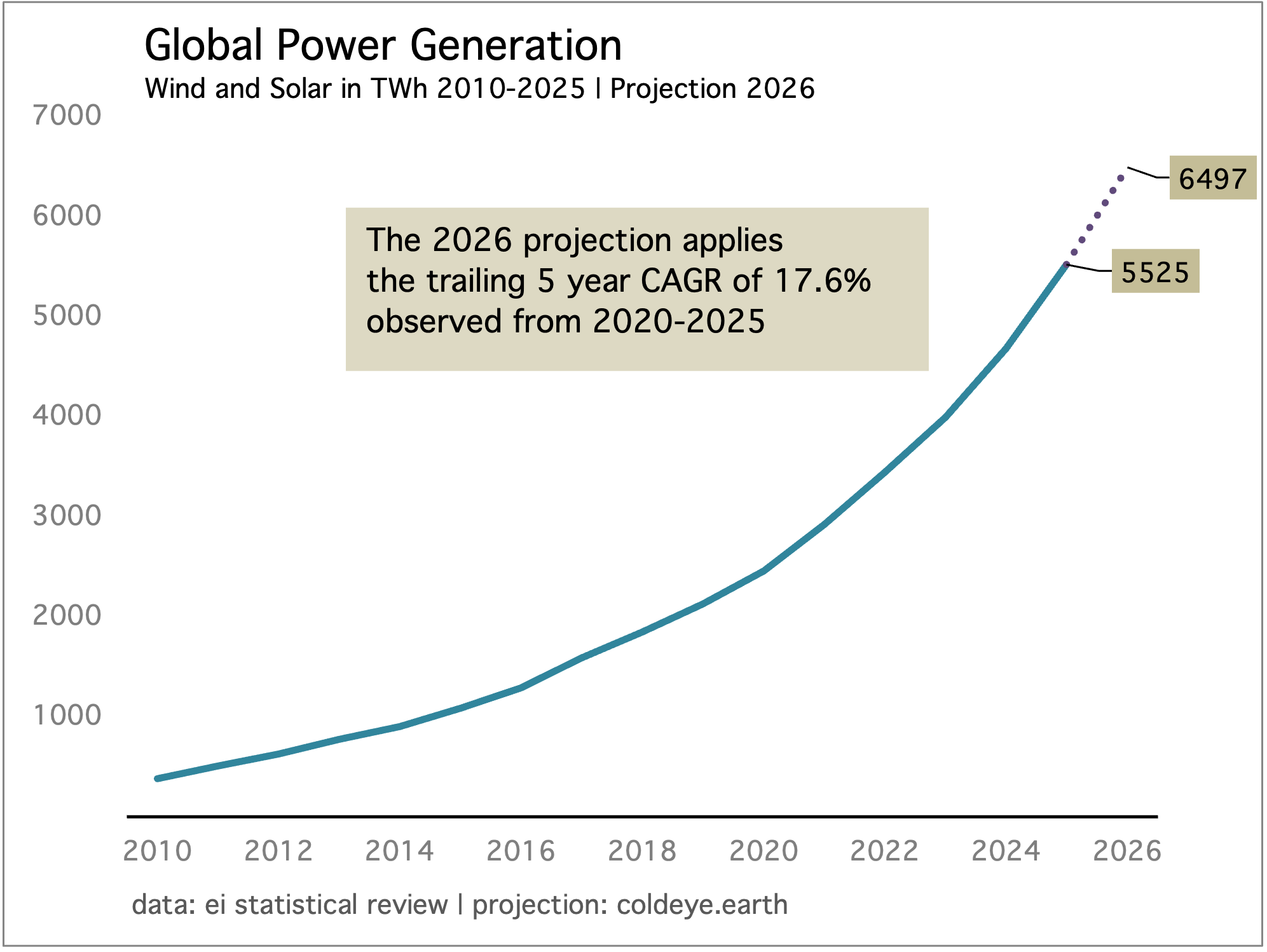
Because we are still dealing in estimates for 2026, it would not be prudent to try and sift through all the partial data to then produce a new estimate for combined wind and solar generation in 2026. But simply put, last year’s growth spike that went beyond forecasts is about to be met with a far lower-growth year, which will bring that exuberant growth rate back down again, from 17.6%.
In the big picture, however, we must remind ourselves why this matters so much. Decarbonization of the global power sector requires a two-step process in which we first stamp out any further growth from fossil-fuel generation and then proceed to drive that dirty generation into decline. In 2025, we finally reached the first step when all sources besides wind and solar saw their growth halt. Needless to say, that is very, very far away from the kind of progress many expected to see by now, here at mid-decade.
Global oil is returning to a healthier balance between supply and demand, according to the latest assessment from the IEA. Demand has fallen hard this year, by nearly 3 million barrels per day (mbpd), which is a deceleration so large you would think we had entered a global recession. What’s worse for the oil industry, supply is growing strongly again. No wonder oil prices have reflected that, behind the curtain of the Iran War, organic demand growth is nowhere to be seen. From the most recent Oil Market Report (OMR) from the IEA: