

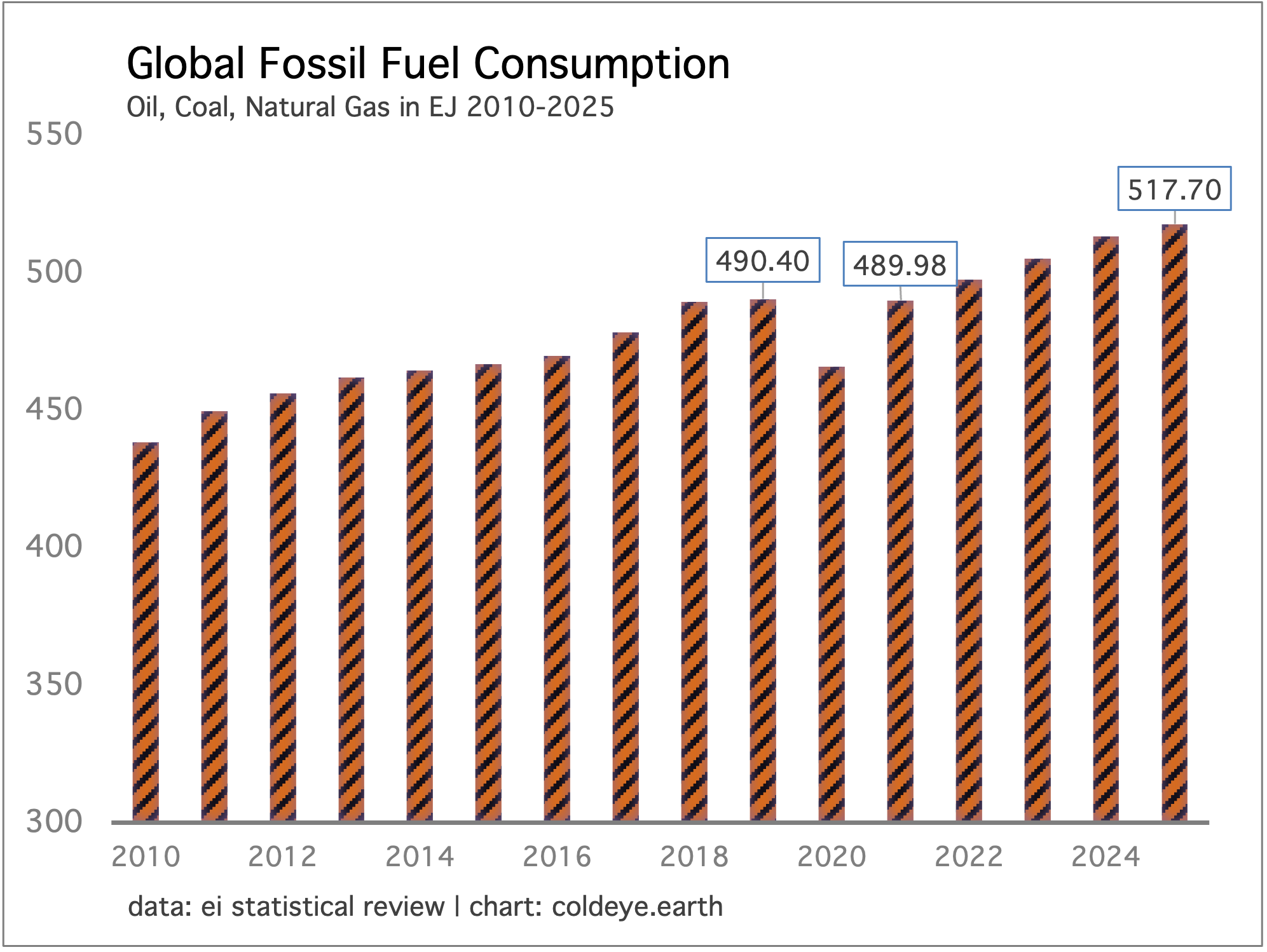
Global consumption of fossil fuels has been climbing at a steady rate since the pandemic, at roughly 1.25% per year. That’s exactly the kind of rate that makes it difficult to rein in their growth. From roughly 490 exajoules (EJ) in 2021 to 518 EJ last year, the three fuels combined have advanced by an aggregate 5.65%. This relentless onward march has occurred during a time when coal in power in both the U.S. and the EU has crashed further, and as China has greatly slowed its consumption of oil.
There are two types of very powerful growth: when small things grow fast and when big things grow slowly. New technologies—everything from the adoption of new devices and appliances to the growth of wind and solar—are powerful when they grow fast from small beginnings. But when large systems, from energy consumption to the national debt to population, grow at a slow rate, the compounding effect can be quite powerful. If you want to catch a big thing growing slowly, therefore, you may not only need the help of small things growing quickly, but a separate strategy to get the big thing’s growth rate decisively back below 1.00%. Should global consumption of fossil fuels maintain their 1.25% growth rate over the next five years, total global consumption will reach 551 EJ in 2030. That would make for an aggregate addition of 61 EJ over the 2021 level, or a total advance of 12.4%. (For context, because EJ are hard to visualize: The entire EU ’s energy consumption last year stood at 72 EJ.) Compounding: It adds up.
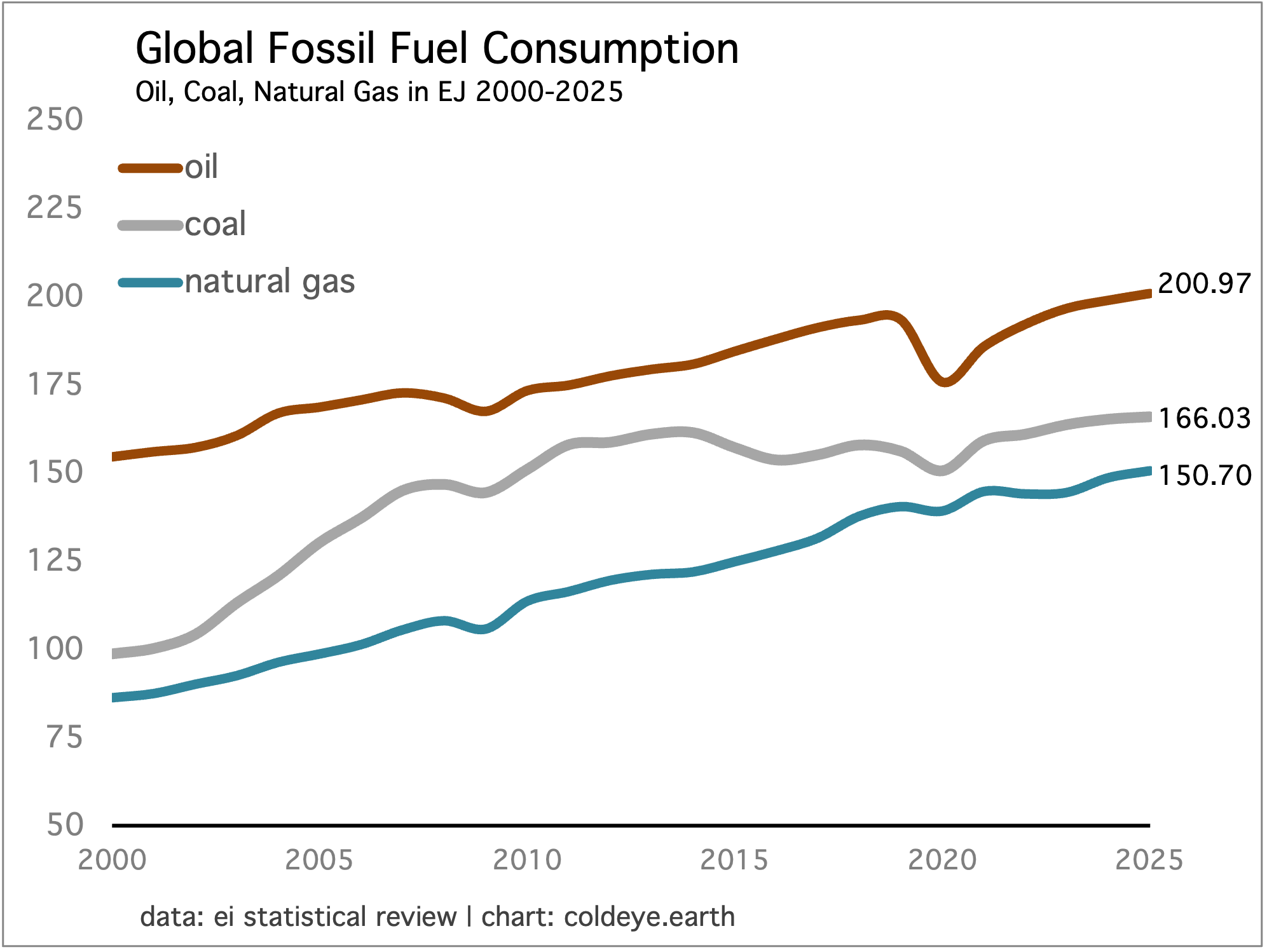
Coal remains the world’s second-largest energy source, despite rapid gains by natural gas to catch up, from third place. When we look at the three individual fuels on their own, we can see pretty easily the slowdown in global coal growth as wind and solar, natural gas, and more aggressive policies have joined together in opposition. To the extent that natural gas emits at least 50% less CO₂ than coal, on a combustion basis, it’s a victory that a great deal of potential coal growth has been curbed. The alternative view is that coal has been able to continually squeak out successive new highs of consumption, despite being attacked from all sides. The persistence of coal—19th-century relic and undisputed leader of the industrial revolution—even in light of the additive model of energy transition, is frustrating if not mind-boggling.
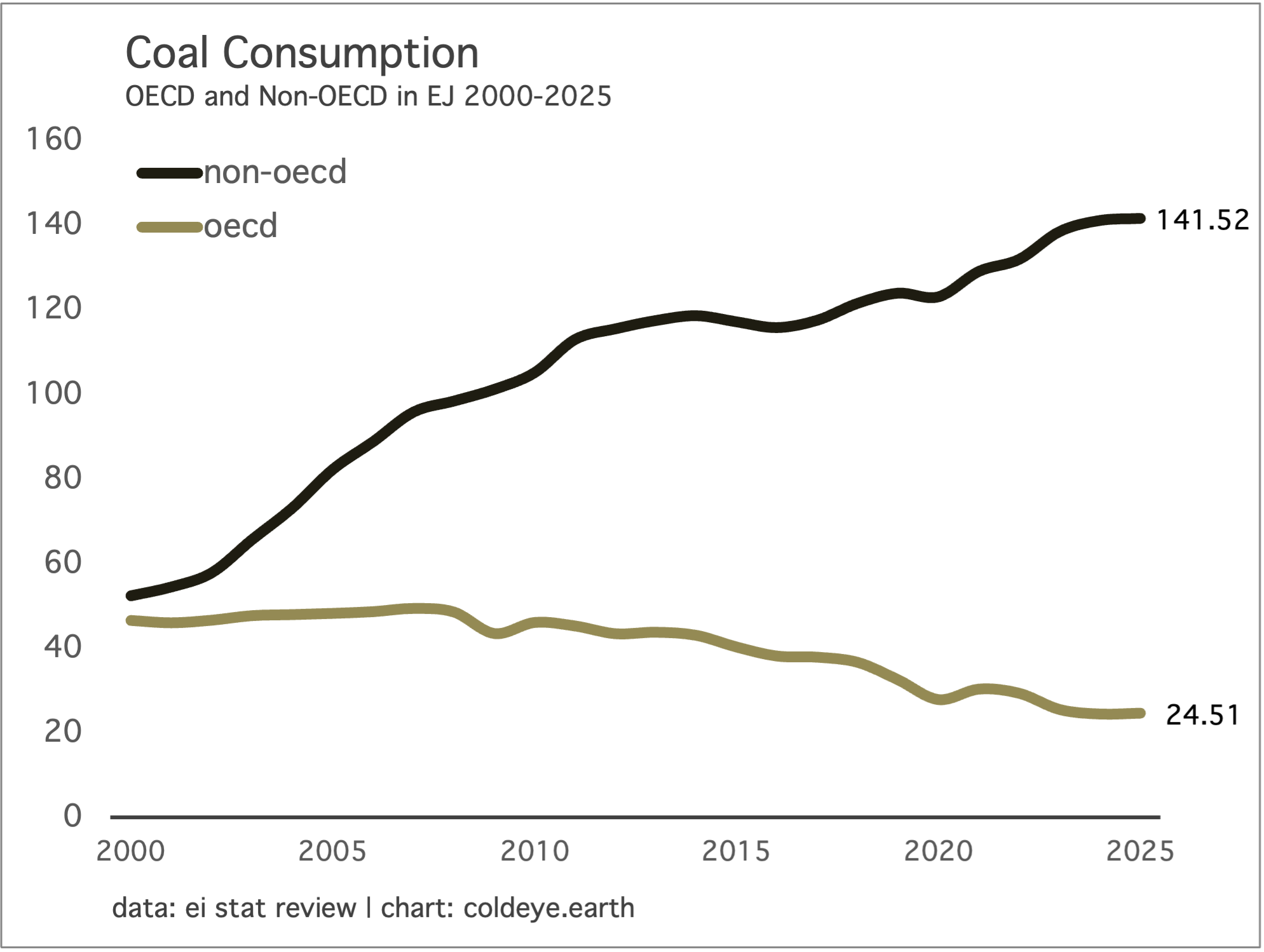
When we break global coal growth down to its two constituent parts, there’s a clear story to be told. One of the common hopes for wind, solar, and storage is that they would be particularly competitive in less developed countries, the non-OECD, where they would fight fewer incumbents. It was theorized, just as with mobile phone adoption, that many of these young countries would essentially “leapfrog” to the latest technology, in contrast to the OECD, where incumbency had long been established. As it turns out, new demand for coal has been far more robust than anticipated. If we ask, “Which has been more powerful in wind and solar’s growth, its affordability or supportive policies?” one would have to lean toward policies. This is another way to think again about the nuanced difference between cheap and crazy cheap: Wind and solar and storage are the former, not the latter. If they were crazy cheap, they’d be unstoppable in the non-OECD.
Wind and solar and storage are of course growing quite nicely in the non-OECD, especially in China. But so far, they are playing the additive role, as coal consumption and natural gas consumption press onward. Good news, however: Data shows that China, at least for one year, brought coal growth down to zero in the power sector. And because of China’s massive weight in the index, that alone dragged down power-sector fossil fuel growth in the non-OECD also to zero last year. That will be a very hard achievement to sustain, but let’s hope it can be achieved. As you can see in the chart below (interactive on a web page—can be moused over for data—but not in mobile), wind and solar took a full 100% of total non-OECD power-sector growth last year. When you consider the relentless growth of power demand in general across the non-OECD, that’s encouraging. However, as seen in other large domains, wind and solar taking 100% of marginal growth leads to an increasingly familiar and frustrating juncture: great news to have arrived at that precise spot, but a wall of incumbency tends to block further progress. The layers of the additive model strike again.
China remains the world’s best hope to shut down economically viable fossil fuel power generation, using brute force. As a command economy, China has the freedom to pick winners and losers, to force losses on any sector they deem. China is not constrained, as we are in the West, by the sanctity of private property. One could argue they have already started down this road, given their massive buildout of wind and solar, and that through this massive buildout they are creating ever larger spare capacity in their coal fleet, therefore degrading its economics. The only hitch there is that in the past few years, when summer heat or winter cold have moved to extremes, China has been forced to turn to its mighty coal fleet to meet such spikes in demand. For the moment, therefore, we might conclude that China has taken definitive steps to undermine the future viability of its coal fleet but has stopped short of making the more decisive move.
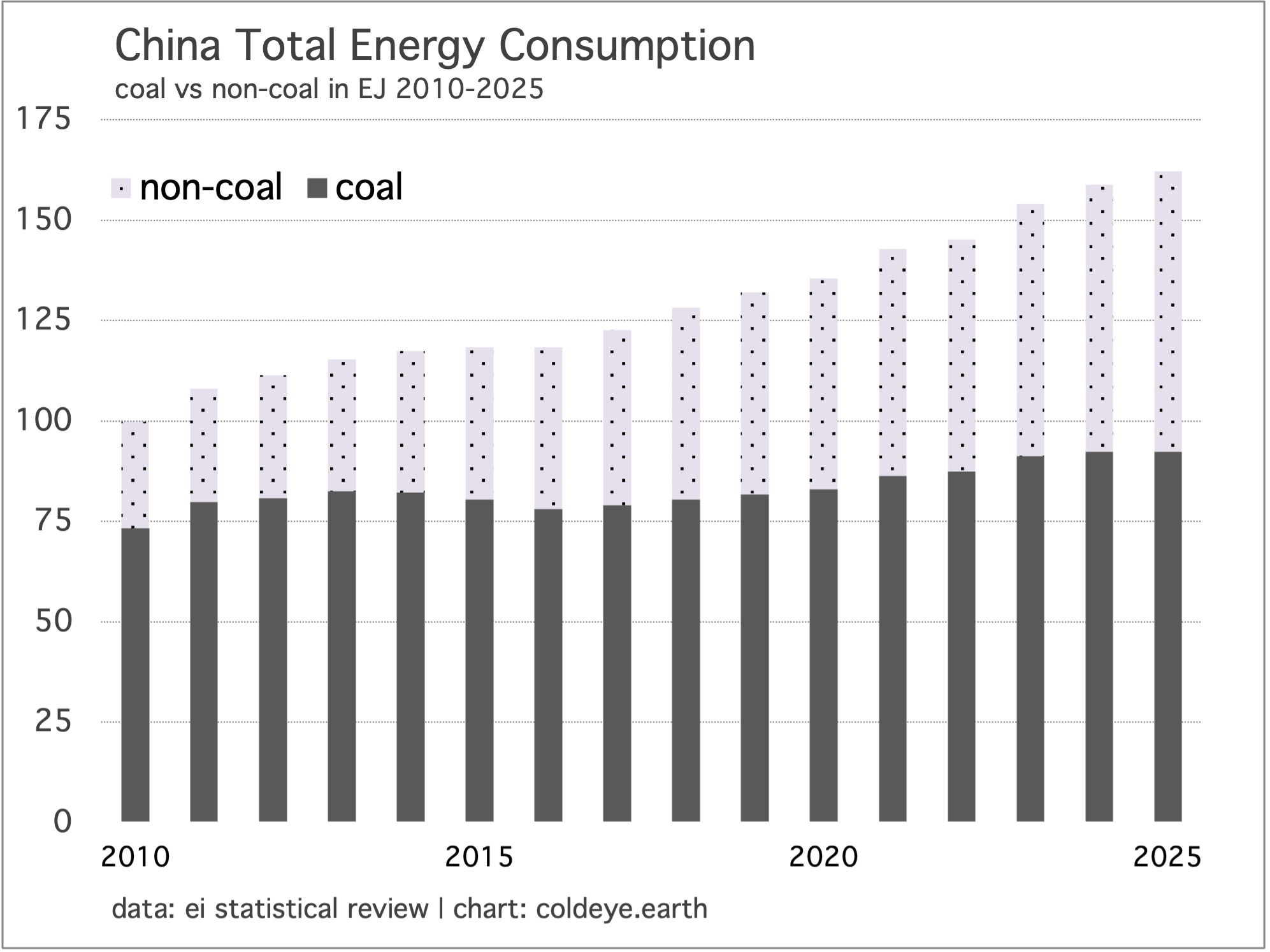
At the current juncture, unfortunately, total coal consumption in China continues to advance, even as the country has done a good job trying to fund growth with an array of other sources. So, to its credit, coal has fallen as a share of total energy use, but alas, coal marches onward in China, reaching new highs in both 2024 and 2025.
It’s instructive to add a throwback chart here, showing the moment in the early 1960s when global oil consumption, having risen steadily since the 1930s, finally overtook coal as the world’s top energy resource. (Note: The unit of account here is the Mtoe, as this is from an older BP Statistical Review dataset. And yes, just like Btu or EJ, an Mtoe—a million metric tons of oil equivalent—is a unit of heat.) Understandably, at the time, oil’s versatility convinced people that it would snuff out coal, especially since oil was a liquid and thus far more adaptable than old, solid coal. Sixty years on, however, we’ve learned that coal can still perform many industrial tasks that can’t be undertaken as easily, either with natural gas or versatile oil.
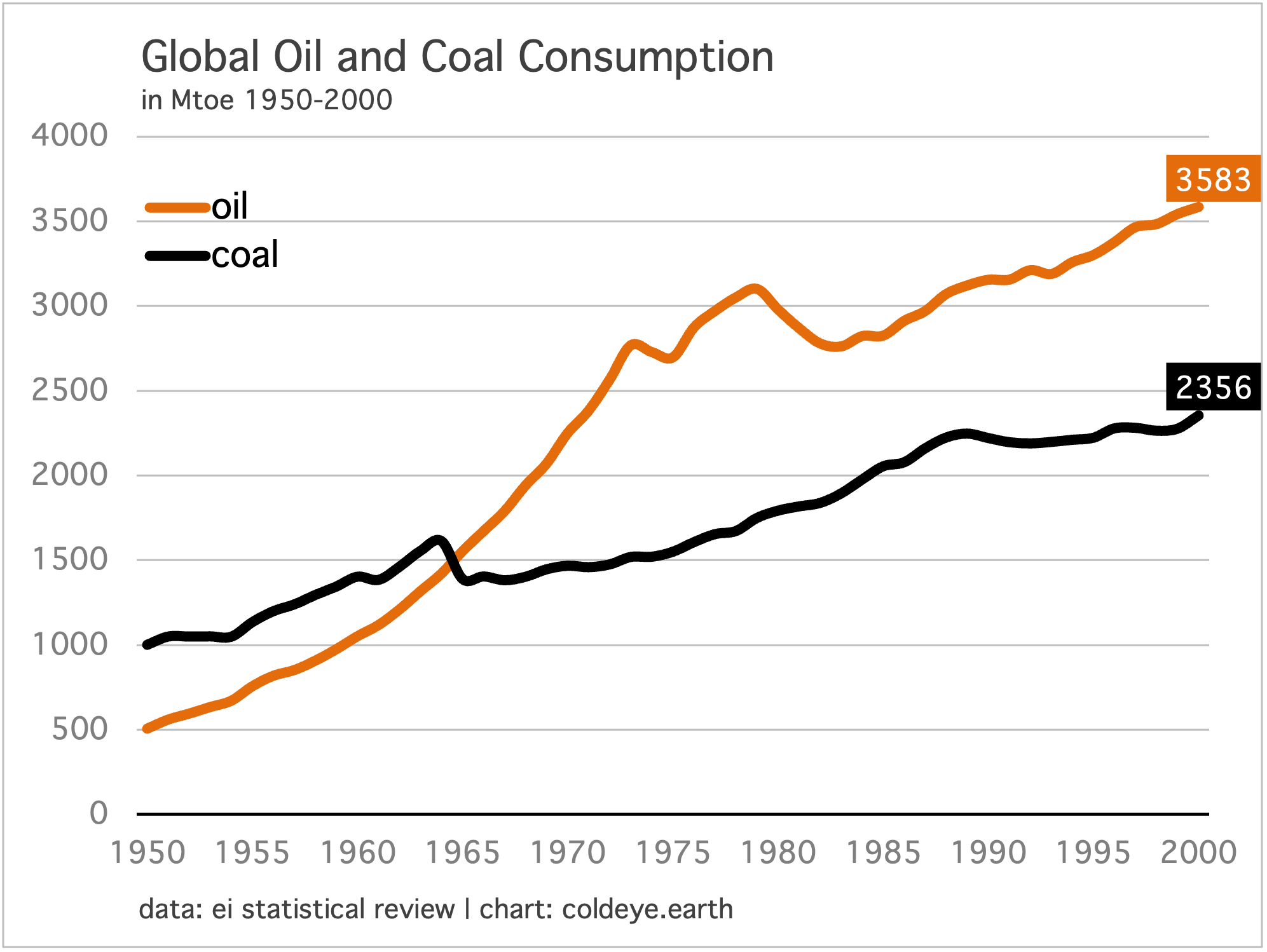
The front end of any energy transition is convincing and powerful, as the new energy source chews its way quickly through a universe of new opportunities. The early years for coal as it overthrew wood, and oil as it overthrew coal, were positively dizzying. The past 15 years for wind and solar have been similar. From a small base, wind and solar are competing beautifully for marginal growth in power and, because they are sources of electricity, are far more adaptive to a digital world that runs on software and, yes, AI. Wind, solar, batteries, and technology fit together in ways that are modern. Coal, by comparison, is almost comically archaic. Coal is dumb, crude, inefficient, and yet packed with powerful energy that creates high heat. The heat from combustion remains crucial to global industrialism—crucial especially to creating all the steel in the ground necessary to mount new energy infrastructure, like wind and solar, for example. In renewables, the world has happened upon clean energy, and, for the most part, clean electricity. What the world lacks is a way to create heat at scale, without the associated emissions. It’s a tough and so far insurmountable reality.
—Gregor Macdonald