

In the current energy transition, the most important metric to follow is how much of yearly global power demand growth can be covered by low-carbon resources. Cold Eye Earth, along with its preceding publications (gregor.us and terrajoule.us), has tracked this metric for over a decade, hoping that this threshold would soon be crossed. But with the exception of a couple of years when total wind and solar grew moderately toward that target, we have continued to wait patiently for a better outcome. (Total global power demand actually fell in the pandemic year, 2020, but the that year remains an unhelpful outlier in all datasets.)
Through the first three quarters of this year, however, reporting indicates that total global demand growth for power is coming in much lower than forecast, which considerably lowers the bar for combined wind and solar to meet all new demand. This is surprising. Not on the wind and solar side of growth, but rather that total growth, which is supposed to be running at 4.00% or so, is coming in lower, reportedly at just 2.7%. Given all the drama and excitement over accelerated AI-driven demand for power, one has to wonder why the high rate forecast, coming from the IEA, for example, is not coming true.
London-based think tank Ember, which tracks this progress, has just reported its latest year-to-date estimate:
In the first three quarters of 2025, solar generation rose by 498 TWh (+31%) and already surpassed the total solar output in all of 2024. Wind generation grew by 137 TWh (+7.6%). Together, they added 635 TWh, outpacing the rise in global electricity demand of 603 TWh (+2.7%).
As previously discussed in the November 10 issue, wind and solar generation growth this year continue to track with the simple (if not simplistic) growth model used by Cold Eye Earth, which projects the two technologies will advance by 775 total TWh this year. But if they have already grown by 635 TWh through Q3, then they may complete the year at a level higher than that projection, above 800 TWh. That’s great news for wind and solar, but also for the Cold Eye Earth model, which may have correctly estimated this year’s growth within 5%.
The big miss here, again, is total demand growth, which is also on pace to come in around 800 TWh—leaving a big gap against the ongoing IEA forecast. In the chart below, Cold Eye Earth previously modeled its usual year-to-year wind and solar growth forecast, and also a three-year run of total demand growth of 4.0% per year. (Note that there are small discrepancies in the comparison of 2024 to 2025’s total demand growth because 2024 was a leap year.)
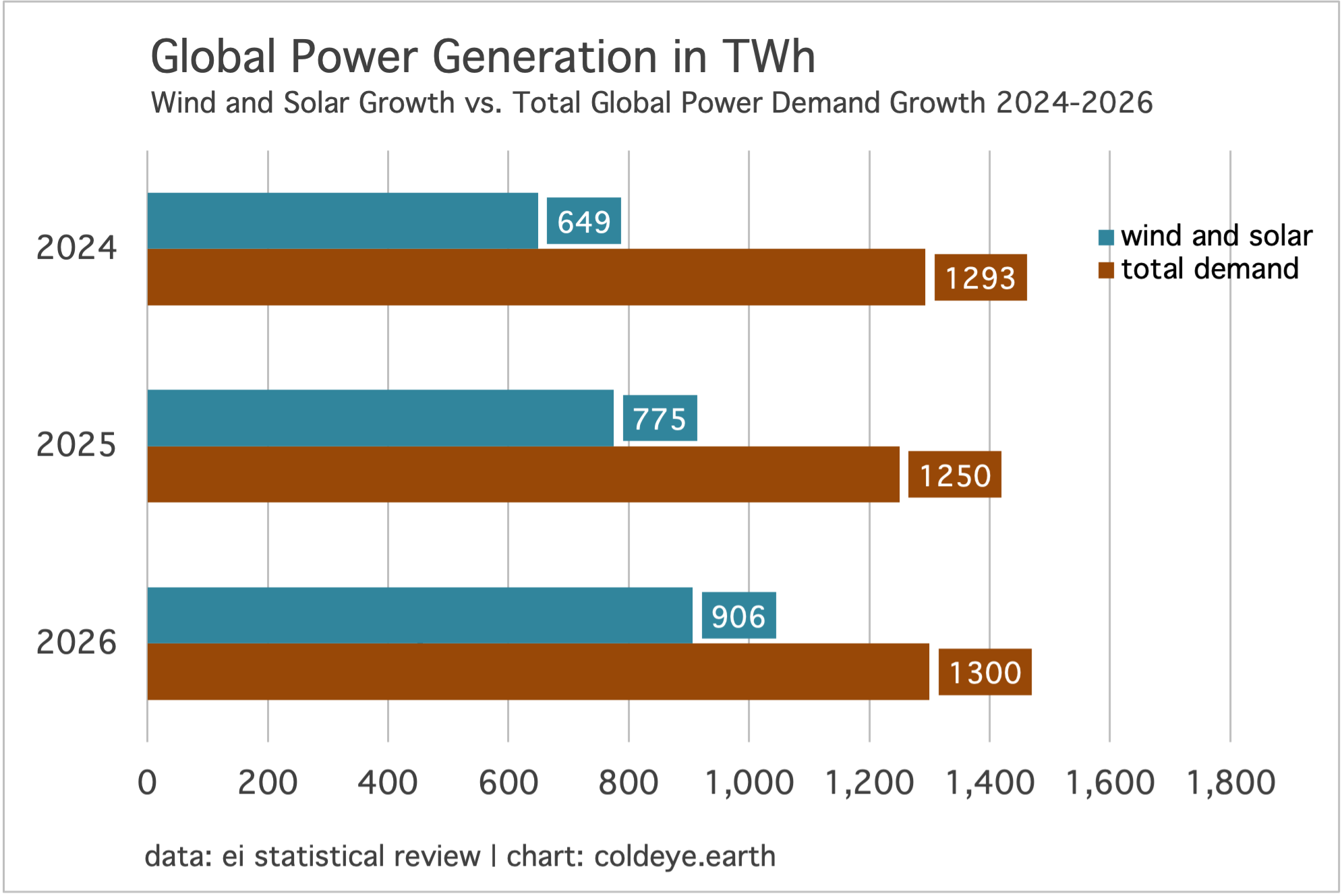
If total global power demand comes in at just 64% of the forecast this year (800 TWh vs. 1250 TWh), not only will it be a nice illustration of how dominant this factor is to the direction of energy transition, but it will also suggest that much of the expectation of higher growth from AI-related workloads has not yet landed. Other factors that might explain the miss: lower global economic growth as a result of disruptive U.S. trade policies, and there may be weather-related effects too. As we know, extremely hot years can cause global air-conditioning to spike. And any easing of that demand, from an anomalous cool summer, would have the opposite effect. It’s also good to remember that real-time data collection has higher error-risk. After all, even data that’s gathered retrospectively often has to be revised also. (Agencies like the U.S. EIA revise data continually.) So, Ember’s estimate of total demand will likely be revised. But, by how much is uncertain. Finally, there is the forward march of energy efficiency, but that is a small and steady factor and certainly could not account for the huge difference between 2.7% and 4.0% growth of global power.

Progress in AI is pressing onward as a new round of models are released. Google’s Gemini 3 was let loose about three weeks ago and has wowed the tech community with its stellar capabilities. Claude Opus 4.5, from Anthropic, emerged a few days later. And rumor has it that OpenAI—which reportedly sounded the alarm over this mounting competition with a company-wide memo, calling a code red from Sam Altman—has decided to hurry up and release its latest version of ChatGPT this coming week.
Your faithful correspondent thought it might be useful, therefore, to report how these models actually perform on a real-world task. The usual province of Cold Eye Earth is to report, of course, on all the energy demands that might emerge from AI. But there has been so much public focus on that theme that it’s left a deficit of reporting on how AI might work for the average person. In this case, we’ll take a look at how these models handle taxes and financial planning.
Background: I have a fairly complex tax picture that begins with having been a longtime independent worker whose earned income is exclusively reported on Schedule C, for small businesses. This means I have a number of deductions that come through that channel, from annual healthcare premiums to the qualified business income deduction. I also have a Roth IRA, a regular IRA, inherited IRAs, and a personal (Solo) 401(k). Looking further ahead, over the next ten years there will come the question of Social Security (and when to start taking it). And finally, all these factors weave into Oregon State tax laws, as I live in Portland. For example, Oregon’s tax return starts with the federal AGI (adjusted gross income) and Social Security is not taxed in Oregon. However, Oregon has a very progressive income tax table (partly owing to the fact that we have no sales tax on anything—not even meals or alcohol) and therefore smoothing income, when possible, to avoid annual spikes is of some benefit in this state. One area of tax simplification that has occurred since 2020 is the introduction of a new, super-high standard deduction at the federal level, which has wiped out itemized deductions in the housing area for many—though certainly not all.
Traditionally, I’ve handed all this work over to “a tax guy.” Here in the U.S., having a tax guy is your best choice to navigate the ridiculously complicated U.S. tax code. I inherited one of these wizards from my parents, back in Massachusetts. Because I’m a “Schedule C guy,” I found that my tax guy routinely pushed back on some of my deduction efforts, while uncovering other deductions hiding under rocks. That’s exactly what you want: all valid deductions taken, while steering clear of any claims that would violate the rules.
Let’s see how the various AI models handled all these factors. I asked them to estimate my 2025 tax burden in a single scenario, my 2026 tax burden in several scenarios, and then I asked for 10-year projections that started to incorporate either IRA withdrawal or Social Security income or both. To be honest, I had no idea these models could come even close to handling all this information, so here’s an early preview of my conclusions: As the models produce answers and even downloadable spreadsheets, you can almost see in your mind’s eye how so many accounting and financial planning positions will eventually disappear from the landscape.

Claude: Dario Amodei, the CEO of Anthropic, has been clear that the angle his company is pursuing in AI is specialization; and they are largely focused on business customers. They want to develop various speciality channels that would focus on pharmaceuticals, chemicals, biology, math, and science more generally. Claude at the moment has decisively won the computer coding channel, for example. When you hear tech CEOs say that most of their coding workforce now uses AI to write the code, thus leaving editorial work to them, this is why. Unsurprisingly, Claude is also extremely good with numbers and data.
I paid for a subscription to Claude some time ago for exactly this reason. I wanted to analyze some exceedingly large data spreadsheets from the EIA. One of my first queries was asking Claude to estimate the average age of natural gas power plants in the U.S. Longtime Excel wizards might wonder why this query couldn’t simply be accomplished using Excel’s native capabilities. Probably could! But Claude performed double sorting in this task: It had to pick out all the natural gas from every other listed plant type (coal, nuclear, solar, etc.) and then moved on to its second sort. This all happened in a flash, by the way. And yes, it felt like a shazam kind of moment.
So how did Claude do on taxes? Its user interface (UI) is particularly good for these tasks. It unfailingly produces an estimate that is formatted like a professional report, and it offers a spreadsheet version to boot. Claude looks gorgeous. But it got very hung up on the qualified business income (QBI) deduction. To be fair, the IRS’s instructions for Form 8995 are slightly loose, and less clear. But that’s not the only area where Claude had trouble. Its main weakness was being unclear where, exactly, in the order of operations to apply the QBI deduction. Indeed, it was not able to correct this mistake until some time later, when I pitted a different model against it, forcing Claude to admit it had never quite gotten the QBI correct.
Claude also had trouble analyzing the optimal point in the future to start taking Social Security, and interestingly the model had such high confidence in its ability to perform such longer-term projections that it offered these queries to me—only to prove less able to solve them. Indeed, Claude was super eager to spit out all sorts of ancillary analysis: tax efficiency of the Solo 401(k), tax drags from taking Social Security too early, and how best to handle required minimum distributions from an inherited IRA and future withdrawals from regular IRAs. It was as though Claude was super-informed about all these measures and scenarios from a top down view, but then got hung up on the details, and had to correct itself through further prompting. Still, I was very impressed. The AI model eventually delivered to me eventually high-quality estimates. This echoes other reporting on the current ability level of these interactive AI models. They work best when the user has enough knowledge to challenge some of their answers.

ChatGPT: Lightning fast, and exceedingly good, I was surprised that ChatGPT needed a corrective prompt. The glaring error it made was easily avoidable: it completely missed the basic fact that Oregon’s return starts with the federal AGI, and as a result it got all its Oregon estimates wrong. But the fact that ChatGPT got everything else right paints a portrait of a genius who can spit out differential calculus answers while driving a car, but then shockingly blows through a stop sign. “How lazy do you have to be,” I asked, “to get the most basic fact wrong about Oregon’s return?” Chat GPT apologized (all the models apologize a lot) and quickly fixed its error.
When I reported Claude’s answer to the QBI question, however, ChatGPT suddenly went on the offense. “Claude AI made a big error by incorrectly figuring the basis amount, on which to apply QBI!” I acknowledged that ChatGPT was quite right, and it seemed quite pleased with itself and proceeded to produce a bibliography of tax essays and other material supporting its (correct) take. Bottom line: ChatGPT correctly understood that higher contributions to my Solo 401(k) would actually reduce the basis on which to take the 20% QBI deduction, thus making the overall QBI deduction smaller. Again, note the strange asymmetry: ChatGPT made the most elementary of errors on the Oregon return but completely aced a far murkier area of tax law in QBI.

Gemini 3. Gemini 3 got everything right the first time through. That I did not expect. It felt like magic. Actually, it made a small error in calculating my standard deduction, but claimed that the way I had formed and formatted that question had led to its error. Really? Oops. Gemini was right. Which shows that in AI the quality of the query heavily controls the quality of the outcome.
Conclusions: AI is very much all around us and taking place quite actively in the present, even if the narrative focuses on a more distant big-bang future where AI supposedly becomes super-intelligent. The demand is already here, and the productivity effects on labor (as well as the dislocating effects on labor) are already taking place—but in myriad small ways, rather than the revolutionary outcome many are still waiting for. While it’s true that the return-on-investment question looms large for those megacap corporations loading up on chips and data centers, it is no longer possible to imagine how consumers, businesses, and institutions won’t soon become hopelessly addicted to these capabilities. Given that AI is ultimately energy-driven computing power, upward pressure on future power demand is not in question.
U.S. power demand growth in 2025 is also coming in below expectations, and this may go some way to explain why global power growth is falling far short of the EIA’s 4.0% forecast. To be sure, U.S. power demand growth is currently stronger when compared to the past two decades. But the hue and cry over runaway power demand here in the U.S. from rapidly rising AI power demand is simply not coming true. Not yet, at least.
In the department of good news, however, the projected increase from 2024’s total demand of 4393 TWh to this year’s estimate of 4500 TWh has once again been handily covered by growth of combined wind and solar. And given that wind growth this year is awful, barely above 1.0%, indicates that the heavy lifting is being done by solar. The all important ratio is looking pretty good, therefore, here in the U.S. This leaves only the ongoing question of when, if anytime soon, fossil fuel power generation will actually fall.
—Gregor Macdonald